
Comparison of Uniformity Testing between Horizontal and Vertical Mixers
Mixing uniformity directly determines the spatial distribution consistency of fertilizer nutrients, thus affecting granulation rate and product qualification rate. Horizontal and vertical mixers are the two most widely used types of mixing equipment, but their structural differences lead to drastically different mixing mechanisms and uniformity performance. This article compares the uniformity curves of the two types under the same material conditions using experimental data based on standard testing methods, providing a quantitative basis for process selection.
Testing Method: Tracer Method and Sampling Specifications
The uniformity test was conducted using the sodium chloride tracer method. Dicalcium phosphate (moisture content 12%, bulk density 0.85 g/cm³, particle size 0.5–2.0 mm) was used as the carrier, and tracer was added at a ratio of 1:99. The total loading was 60% of the effective volume of the horizontal mixer and 70% of the effective volume of the vertical mixer (both according to the recommended loading coefficient of the equipment). After mixing begins, samples are taken from nine fixed points at the mixer outlet cross-section at preset time points (30 s, 60 s, 120 s, 180 s, 300 s, and 600 s). Three parallel samples (approximately 50 g each) are taken from each point. After dissolving and filtering, the chloride ion concentration is measured using a conductivity meter, and the coefficient of variation (CV) at each time point is calculated. A CV ≤ 5% is considered the acceptable standard for uniformity.
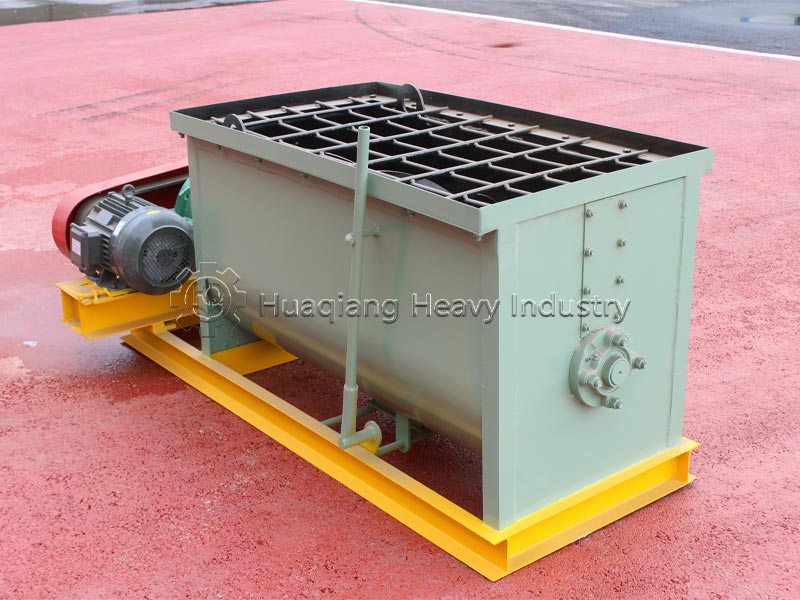
Data Curves and Uniformity Evolution Patterns Test results of the horizontal twin-shaft paddle mixer: At 30 s after startup, the CV value was 38.5%, and the material still exhibited obvious stratification; at 60 s, the CV value rapidly decreased to 18.2%, with the high-speed scattering action of the paddles causing convection circulation of the material; at 120 s, the CV value dropped to 6.7%, approaching the acceptable threshold; at 180 s, the CV value reached 4.2%, entering the uniform range; at 300 s, the CV value stabilized at 3.0%–3.5%, and remained at this level until 600 s without significant change. The time required for the horizontal mixer to reach the acceptable standard is approximately 180–240 s.
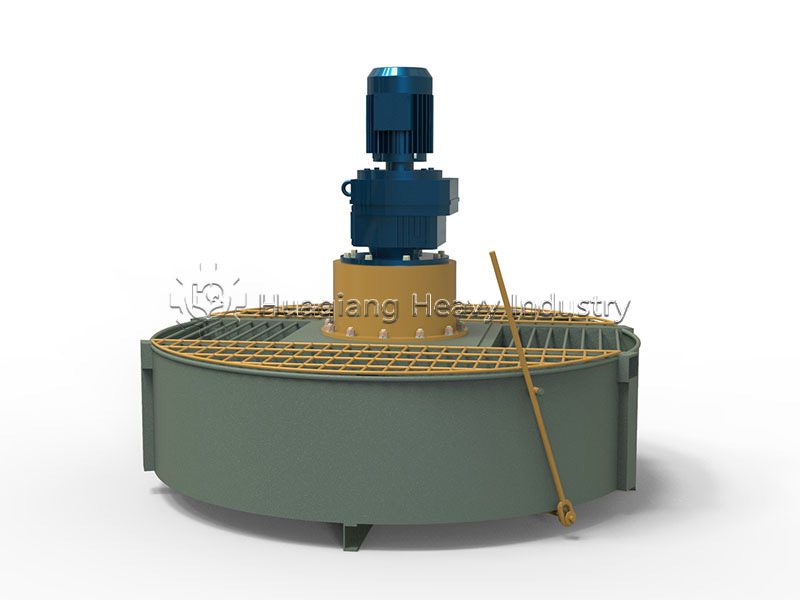
Test results for the vertical screw mixer: At 30 s, the CV value was 52.1%, due to localized convection in the initial stage of screw lifting; after 60 s, the CV value decreased to 32.5%, but axial mixing of the material lagged; at 120 s, the CV value was still as high as 21.3%, far exceeding the 18.2% of the horizontal mixer during the same period; at 300 s, the CV value finally decreased to 8.9%, close to the acceptable threshold; at 600 s, the CV value finally stabilized at 5.6%–6.2%, barely reaching the lower acceptable limit. The time required for the vertical mixer to reach the acceptable standard was 480–600 s, approximately 2–3 times that of the horizontal mixer.
Comparing the CV value curves of the two sets over time reveals that the slope of uniformity decrease in the horizontal mixer during the initial stage (0–120 s) is approximately 2.5 times that of the vertical mixer, indicating a significantly superior initial mixing rate; however, the difference in the final CV values during their respective stable periods is approximately 2.5 percentage points. Furthermore, after mixing for 600 seconds and then stopping and allowing to stand for 60 minutes, the discharge CV value of the horizontal mixer increased from 3.2% to 3.9%, an increase of 0.7 percentage points; while that of the vertical mixer increased from 5.8% to 8.6%, an increase of 2.8 percentage points. This indicates that the vertical mixer is more prone to stratification and segregation due to differences in material density.
III. Conclusions and Selection Recommendations Based on the above measured data, the following conclusions are drawn: The horizontal mixer is significantly superior to the vertical mixer in reaching the uniformity standard, with a mixing cycle that is approximately 50%–60% shorter, and the finished product has stronger resistance to segregation; although the vertical mixer can barely achieve the final uniformity standard, it takes longer and is sensitive to differences in material density, making it unsuitable for processing compound fertilizers or materials with large differences in formulation. The following selection recommendations are made: For compound fertilizer production lines that require frequent formula changes, rapid mixing, and large-scale operation, horizontal twin-shaft paddle mixers are preferred. For premixing processes of single-variety organic fertilizers or bio-fertilizers with small output and similar densities of material components, vertical mixers remain suitable due to their lower equipment cost and smaller footprint. Regardless of the model chosen, it is recommended to conduct trial runs under identical conditions with the target material before actual production, and determine the optimal mixing time based on the measured CV value curve, rather than setting it arbitrarily based on experience.
The uniformity test data clearly demonstrate that the fertilizer horizontal ribbon mixer (twin‑shaft paddle design) significantly outperforms the vertical disc mixer in both mixing speed and final homogeneity, achieving a CV ≤5% in 180‑240 seconds compared to 480‑600 seconds for the vertical unit—a 50‑60% reduction in cycle time. This rapid, consistent blending is essential for the entire organic fertilizer production process, as homogeneous feed directly impacts granulation efficiency, product strength, and nutrient consistency. The superior performance of the horizontal mixer makes it the preferred choice for production lines that require frequent formula changes or handle materials with large density differences—common in NPK and organic‑inorganic blends. When integrated upstream with an automatic organic fertilizer batching system, the horizontal mixer ensures that every batch meets the target nutrient profile before proceeding to the organic fertilizer combined granulation process (e.g., drum + disc), where uniform feedstock yields higher granulation rates and more spherical pellets. Downstream, a fertilizer drying and cooling machine further stabilizes the granules, locking in the uniformity achieved during mixing. While the vertical mixer may still be suitable for small‑scale, single‑variety premixing due to its lower cost and footprint, the quantitative evidence strongly favors the horizontal twin‑shaft paddle design for any commercial fertilizer plant striving for efficiency, quality, and scalability. Ultimately, investing in the right mixer—and determining its optimal mixing time through tracer tests rather than guesswork—is a foundational step that pays dividends across the entire production line.