
September 26, 2025, Pasir Gudang, Malaysia | Case Study of a Dual-Purpose Roller Granulation Organic Fertilizer Production Line
Pasir Gudang, a major industrial and agricultural region in Malaysia, sees a year-on-year increase in the production of livestock manure and palm oil processing waste. Traditional simple fermentation and powdered fertilizer processing methods suffer from low added value, high transportation losses, and easy spoilage during storage, making it difficult to meet the fertilizer needs of large-scale local planting. To optimize production processes and enhance product market competitiveness, local companies upgraded their roller extrusion granulation production line, completing all on-site installation and commissioning on September 26, 2025, and officially commencing commercial mass production.
This roller granulation equipment differs from traditional wet granulation equipment, featuring a simplified production process. It eliminates the need for drying and humidification equipment, significantly reducing customer equipment investment and subsequent maintenance costs. The equipment boasts excellent material compatibility, processing various types of well-rotted livestock and poultry manure organic fertilizers, and is also suitable for granulation production of NPK inorganic compound fertilizers, bio-fertilizers, magnetic fertilizers, and other products. It is a versatile machine suitable for a wide range of applications. The equipment operates stably with a low failure rate, making it suitable for long-term continuous production in Southeast Asia.
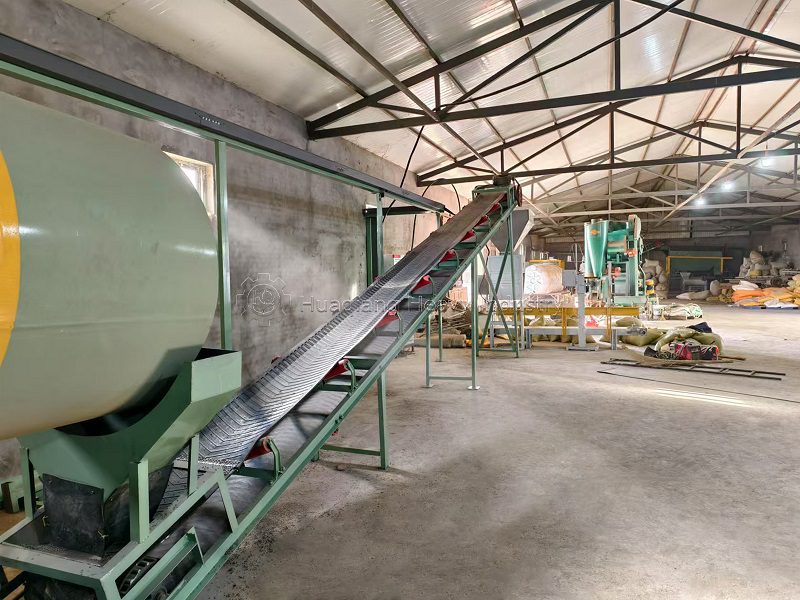
The entire production line is highly automated, requiring only one person to complete daily operations, effectively saving labor costs. The produced granular fertilizer is uniformly shaped, has moderate hardness, and is not prone to pulverization. It also has a longer storage period in the tropical and humid environment, making it ideal for various business models such as local agricultural input wholesale, direct supply to farms, and export distribution.
After the project’s successful implementation, it not only efficiently solved the problems of agricultural waste pollution and disposal in the region, achieving resource recycling, but also helped customers upgrade their fertilizer products, significantly increasing market share and economic benefits. It has become a high-quality demonstration project for large-scale, standardized organic fertilizer processing in southern Malaysia.