
How to determine the maturity of organic fertilizer? Temperature/Odor/Color
The three on-site signals of the maturity endpoint are: the pile temperature drops to near ambient temperature and the temperature difference does not exceed ±2℃ for two consecutive days; the manure/ammonia odor basically disappears and turns into an earthy smell; the color is a uniform dark brown or blackish-brown and the original shape of the raw material is no longer obvious. The arbitration index is the seed germination index (GI): NY/T 525—2021 requires a GI ≥ 70% to be qualified, and a GI ≥ 80% is generally considered fully mature and non-toxic to plants. Odor and color are “screening signals,” while temperature and GI are the “release criteria.” The long-chain cellulose remaining in uncomposted materials will elastically recover during granulation, making the particles difficult to compact; this defect cannot be compensated for by binders.
I. Operational judgment of the three indicators: Where to insert the thermometer, how to grade the odor, how to interpret the color
The reason why on-site judgment of maturity is prone to disagreement is that there is a lack of unified “operational definitions” for the three indicators. By assigning each indicator to repeatable actions, people on different shifts can make similar judgments.
Temperature: Don’t just look at whether it has decreased, but whether it is rising. During the high-temperature fermentation period, the pile temperature typically reaches 50-65℃. After entering the ripening and cooling stage, the temperature drops back to near ambient temperature (approximately 35-45℃). A more crucial signal than “currently low temperature” is the temperature rise after turning the pile: take some cooled material, turn it over, and continue observing. If there is no significant temperature rise after turning, it indicates that the easily degradable organic matter has been largely consumed. Some local technical specifications quantify this signal as “the pile temperature slowly decreases to below 35℃, and the temperature difference remains within ±2℃ for two consecutive days.” Thermometers should be inserted into the center or lower middle layer of the pile, at a depth of at least 30-40 cm, avoiding measurement only of the surface.
Odor: The change from “fecal/ammonia odor” to “earthy smell” is a qualitative change, not a gradual one. The typical odors of uncomposted materials are ammonia, fecal, sour, or putrid. Chicken and pig manure are particularly prone to having a pungent ammonia smell. After composting, these pungent odors should be significantly reduced, the original odor of the manure should be largely eliminated, and the main odor should become similar to that of soil or humus. A direct, operational auxiliary judgment method is to take a small amount of material, wrap it in aluminum foil, and gently heat it from below with a lighter. If a pungent odor is emitted, it usually indicates that the material is not yet fully composted. It should be noted that “a slight ammonia smell” is accepted as a signal that the material is close to being fully composted in some on-site assessments, but if the ammonia smell is still “obvious” or “pungent,” the material should not be released as fully composted.
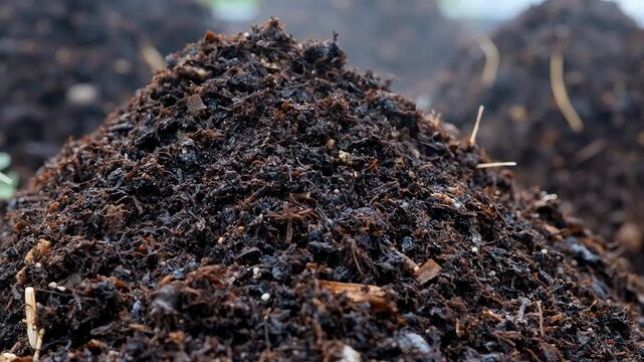
Color: Dark brown is a necessary signal, but not a sufficient one. The color of fully composted material tends to be a uniform dark brown or blackish-brown, the original shape of the raw material (such as chicken manure particles or straw) is no longer obvious, and the uniformity of mixing is improved. However, “black ≠ necessarily fully decomposed” is a crucial prerequisite: some materials will darken in color after high temperatures, and color changes can be “faked” by high temperatures, so they cannot be used as the sole basis for determining maturity. The correct way to use color as a criterion is: under the premise that the temperature no longer rises, a uniform darkening of the color and the disappearance of the original shape of the raw material constitute evidence; if the temperature is still fluctuating, even a darker color is unacceptable.
II. From “Insufficient Decomposition” to “Particle Strength”: The Elastic Recovery of Long-Chain Cellulose is the Core of the Conductivity Chain
The impact of decomposition degree on granulation is not an empirical question of “how easy or difficult it is to granulate,” but a strength issue with a clear physical mechanism.
Incompletely decomposed materials such as cow dung and straw contain a large amount of residual long-chain cellulose and active enzymes. When these long-chain fibers are squeezed or sheared in the granulator, they exhibit extremely strong elastic recovery: the material “bounces back” after being compressed, making it difficult for the particles to reach a dense state, resulting in rapid disintegration after exiting the machine or pulverization during transportation. Meanwhile, uncomposted materials may continue to ferment and produce gas after granulation, leading to internal expansion and cracking of the granules, further reducing their strength.
Conversely, thorough composting degrades cellulose into short-chain humic acids, stabilizing the material’s binding and rheological properties, making the granules easier to compact during extrusion or rolling. Practical data also supports this direction: for every 5-day extension of the fermentation cycle, the granulation rate increases by an average of 8%–12%.
This chain of events has clear implications for selection and production: when granule strength is insufficient, if the raw material’s GI or composting signal itself is unqualified, adjusting the binder, moisture, or granulator parameters can only change the “apparent granulation,” not eliminate the elastic recovery brought by long-chain fibers. Insufficient composting is an upstream constraint on granulation strength, not a variable that can be independently repaired by the granulation stage.
III. The Boundary of the Impact of Over-Composting on Granulation: Fibers Are Not Better When They Are “Rotten”
Insufficient composting damages strength, but over-comosting also has its costs, only these costs occur in a different dimension.
In organic fertilizer production, it’s generally unnecessary to pursue “complete decomposition” to the point of excessive organic matter decomposition. Over-decomposition means a large amount of easily degradable organic matter is consumed, the fibrous skeleton is excessively weakened, and humus accumulation tends to stabilize but also becomes “mediocre.” From a granulation perspective, a certain amount of short fibers or a moderately retained fibrous skeleton contributes to the flexibility and toughness of the granules; after the fibers are completely dissolved, although the material is easier to clump, the granules’ “skeletal support” is weakened, and the sensitivity to microcracks during drying and cooling may increase.
This means that the target range for judging maturity should be “complete harmlessness + elimination of phytotoxicity + moderate fiber degradation,” rather than taking “the more rotten, the darker” as the only direction. GI ≥ 70% is the acceptable line, and GI ≥ 80% is the reference line for complete decomposition and non-toxicity; after reaching above 70%, with stable temperature and normal odor, continuing to extend fermentation will result in diminishing marginal returns on granulation strength, while the consumption of organic matter content and capacity occupation will continue. A reasonable production strategy is to use GI (Gross Intake) and temperature stability as release thresholds, and fiber fineness and granulation test results as fine-tuning criteria, striking a balance between “sufficient maturity” and “retaining a suitable skeleton.”

IV. FAQ: Frequently Asked Questions about Maturity Assessment
Q1: If the compost pile doesn’t heat up in winter, does that mean it’s not mature?
Not necessarily. In winter, the ambient temperature is low, and the compost pile dissipates heat quickly. The surface temperature may be close to the ambient temperature, but if the core layer can still maintain a certain temperature and does not heat up again after turning the pile, it may have entered the mature and stable stage. The judgment should be based on the core temperature plus the temperature rise after turning, rather than just looking at the surface or only the “absolute temperature.” If the core temperature is also consistently below 35℃ and does not heat up after turning, and the GI test is qualified, it can be treated as mature.
Q2: The color is already dark brown, why is the GI still unqualified?
Color deepening can be “faked” by high-temperature processes, while GI reflects whether residual toxic plant substances (such as small-molecule organic acids and ammonium nitrogen) have been eliminated; the two do not change synchronously. If the GI is unqualified, fermentation should continue or the process adjusted based on the GI; it cannot be released simply because the color is satisfactory.
Q3: Can granulation be performed directly if the composting degree reaches GI≥70%?
GI≥70% meets the composting degree qualification requirements of NY/T 525—2021, but granulation feasibility also depends on moisture content and fiber fineness. After composting is qualified, the material moisture content still needs to be adjusted to the window of the target granulation route (approximately 25%-35% for wet disc granulation, and even lower for dry extrusion), and long fibers need to be pulverized to an acceptable fineness for granulation. Composting is a necessary condition, but not the entirety of the granulation conditions.
V. Applying Maturity Criteria Across Manure-Based Lines and Turning Equipment
The three release criteria—temperature stability, odor, and GI—should be applied differently depending on the line and turning equipment. On a sheep manure organic fertilizer production line, fiber-rich and relatively dry material can make color and odor misleading, so the temperature-rise-after-turning check and GI should be used as release criteria; on the same sheep manure organic fertilizer production line, a double screws compost turning machine can improve turning uniformity and aeration, but it does not replace GI verification. For a cow manure organic fertilizer production line, long-chain cellulose and bedding straw require sufficient decomposition before granulation, and turning scheduling should be matched to temperature and moisture. In any organic fertilizer production line, maturity should be written into the shift checklist rather than judged by color alone. On a chicken manure organic fertilizer production line, ammonia odor and high viscosity make odor and temperature signals especially important, and a chain compost turning machine should be scheduled to ensure uniform oxygen supply and consistent decomposition. This is how maturity assessment becomes a line-level and equipment-level release decision, not only a laboratory index.