
How to Make Chicken Manure Organic Fertilizer? Moisture and Granulation Methods
The divergence in granulation methods for chicken manure organic fertilizer essentially boils down to where the moisture management costs are allocated. Before fermentation, use sawdust/coconut coir to reduce the moisture content of fresh chicken manure from 70%-80% to 50%-60% to complete the composting process. If the moisture content remains at 30%-40% after composting, a wet method (stirring/disc) can be used, but drying is essential. If drying is desired, the moisture content needs to be further reduced to 18%-22% using a dry method with roller extrusion. Direct extrusion of fresh chicken manure will inevitably clog the mold. Solid-liquid separation or dehydration before fermentation is a common prerequisite for any method; the difference lies only in that “the wet method uses heat to remove water after granulation, while the dry method removes water before granulation.”
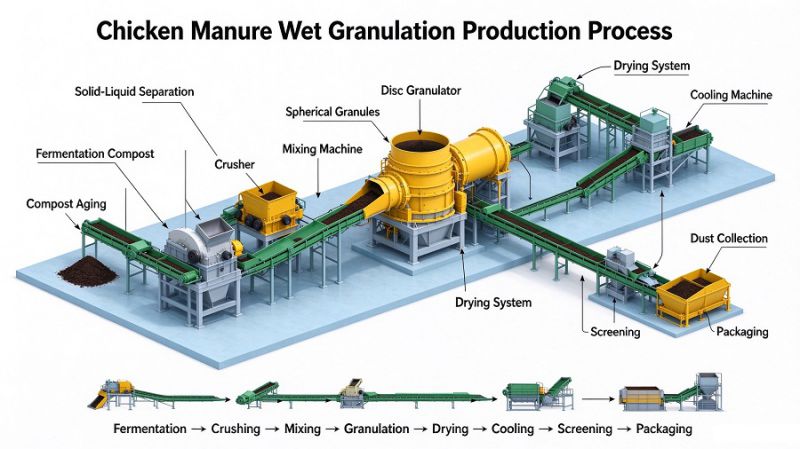
I. Chicken Manure – Auxiliary Materials – Fermentation Moisture: Moisture Adjustment Begins Before Entering the Fermentation Tank
Fresh chicken manure typically has a moisture content of 70%-80%. This moisture level is unsuitable for direct fermentation (prone to anaerobic digestion, strong ammonia odor) and also unsuitable for any granulation process. The first intervention in moisture adjustment occurs before the chicken manure enters the fermentation tank.
Auxiliary Material Selection and Ratio. Sawdust and coconut coir are the most commonly used carbon source auxiliary materials for chicken manure fermentation. In terms of operational procedures, the ratio of dry chicken manure to dry sawdust can be approximately 2:1, and the ratio of dry chicken manure to dry coconut coir approximately 3:1. Simultaneously, the carbon-to-nitrogen ratio should be adjusted to 25:1-30:1, with 25:1 being optimal. The role of the auxiliary materials is not merely to “absorb water,” but more importantly, to establish a porous structure in the compost pile, allowing oxygen to permeate—a prerequisite for initiating aerobic fermentation.
The Endpoint of Fermentation Moisture Adjustment. The moisture content of the mixed materials should be adjusted to 50%-60%. The on-site judgment standard is that “when lightly squeezed into a ball, water seeps out between the fingers but does not drip.” This moisture content is higher than the 30%-40% required for granulation; it is the fermentation window, not the granulation window—moisture in chicken manure organic fertilizer production needs to be managed in two stages and cannot be based on a single figure throughout the entire process.
Moisture state after composting. After 30-40 days of fermentation and when the temperature drops to near ambient temperature, the moisture content of the compost pile will decrease due to evaporation and turning, but it will still often fall within the 30%-40% range. If the compost moisture content is still greater than 30%, it can be further reduced by extending the aging process and periodically turning the compost. The final moisture content at this stage directly determines which granulation route can be taken later.
Direct implications for granulation decisions: A moisture content of 30%-40% after composting is the feed window for the wet process route, but it is also the starting point for the dry process route to continue reducing moisture. If the moisture content can be reduced to below 25% during fermentation and aging, the pretreatment burden of dry extrusion will be significantly reduced. If the moisture content remains above 35% for an extended period, wet extrusion combined with drying is almost the only viable continuous production solution.
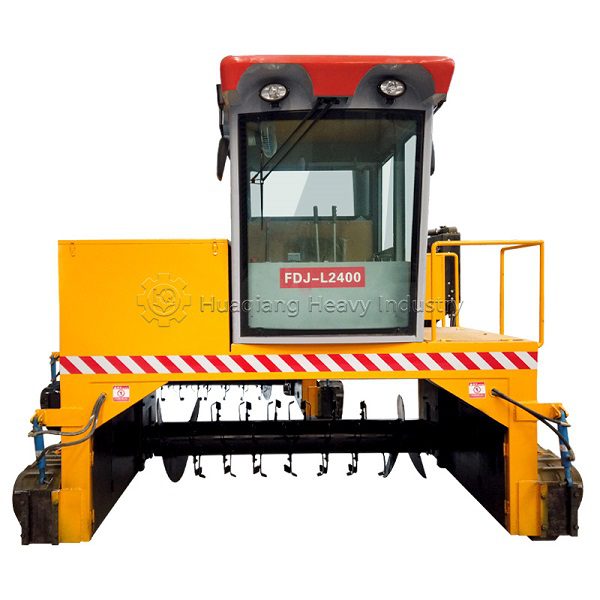
II. Wet vs. Dry: The difference in investment and energy consumption lies not in the pelletizer, but in the “drying” process.
The price difference between the two main routes for chicken manure pelletizing at the individual machine level is far smaller than the cost difference at the overall production line level. The real dividing line is whether a drying system is incorporated into the process flow.
| Comparison Dimensions | Wet Process (Stirring Teeth / Disc) | Dry Process (Double Roller Extrusion) |
|---|---|---|
| Process Flow | Fermentation → Crushing → Batching → Granulation → Drying → Cooling → Screening → Packaging | Fermentation → Crushing → Batching → Double Roller Extrusion → Screening → Packaging |
| Feed Moisture Window | Approx. 28%—35% (Optimal 28%—32% for disc) | Approx. 18%—22%; the drier, the smoother |
| Core Energy Consumption | Drying heat consumption + cooling power consumption; energy consumption of the whole wet process can exceed 60% ① | Only power consumption of the extrusion main machine; approx. 8—12 kWh per ton of fertilizer, saving over 60% compared to the wet process |
| Need for Hot Air Furnace/Boiler | Yes, and requires supporting dust removal and exhaust gas treatment | No |
| Whole Line Equipment Composition | Large number of equipment, including dryer, cooler, and hot air furnace | Can eliminate dryer + cooler + hot air furnace. For a 50,000-ton/year line, this alone saves 150,000—200,000 RMB in equipment investment and 120—150 ㎡ of plant space |
| Granule Shape | Spherical, good roundness | Irregular cylindrical / oblate |
| Core Wear Parts & O&M Risks | Dust accumulation and blockage in hot air equipment of the drying system; high maintenance frequency | Wear of roller skin/mold, but no high-temperature operation, slow wear of parts ② |
Key Conclusion: The “expensiveness” of wet extrusion is not due to the pelletizer itself, but to the use of heat to remove water. The “economicalness” of dry extrusion is not due to the extruder, but to the elimination of the need for a hot air system. If the moisture content of the chicken manure can be stably reduced to below 20% after composting, dry extrusion has a structural advantage in terms of investment and operating costs. If the moisture content remains between 30% and 40% for an extended period, although wet extrusion combined with drying has higher energy consumption, the process chain is complete and can operate continuously.
A trade-off easily overlooked: The dry process eliminates the need for drying, which also means skipping the final step of high-temperature sterilization. Chicken manure poses a higher hygiene risk than general organic raw materials. If the harmlessness treatment in the fermentation stage is incomplete, the dry process at room temperature will not provide additional sterilization. Therefore, the dry process actually places higher, not lower, requirements on temperature management and the degree of decomposition in the fermentation stage.
III. The Position of Solid-Liquid Separation in Chicken Manure Production Lines: It’s Not an “Optional,” but the “First Cut in Moisture Budgeting”
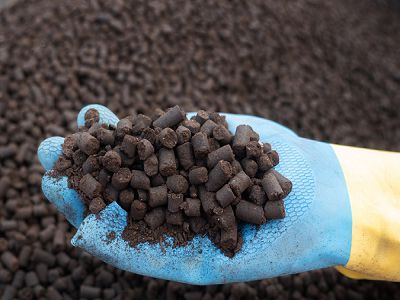
The role of solid-liquid separators in chicken manure organic fertilizer production lines is often misunderstood as “only needed for water-soaked manure.” In reality, its function is to cut off the largest portion of the moisture load before fermentation, allowing for greater operational flexibility in subsequent auxiliary material additions, fermentation tank space requirements, and granulation route selection.
Solid-liquid separators are suitable for high-concentration manure water with a moisture content of over 90%. They can separate chicken manure into liquid organic fertilizer and solid organic fertilizer: the liquid portion can enter a biogas digester or be used directly as liquid fertilizer, while the solid portion has a significantly reduced moisture content, making it easier to transport, stack, and undergo subsequent fermentation. For scenarios where fresh chicken manure has a moisture content of 70%-80%, screw extrusion dehydration can reduce the moisture content from approximately 80% to around 55%, easing the burden on pre-fermentation auxiliary material adjustment.
In terms of process layout, solid-liquid separation should occur before fermentation and before auxiliary material mixing. Its purpose is to reduce the amount of water that needs to be absorbed by the auxiliary materials: the higher the moisture content of the fresh chicken manure, the greater the proportion of sawdust/coconut coir added, and the cost of auxiliary materials and the volume of the compost pile increase simultaneously. Separating and dehydrating first, then using a small amount of auxiliary materials to finely adjust the moisture content to the 50%-60% fermentation window, is more economical than relying directly on dry absorption by the auxiliary materials. If the chicken manure comes from a dry cleaning process and has a low moisture content, solid-liquid separation can be simplified or omitted; however, if the raw material moisture content is close to 80%, skipping this step will result in a larger amount of auxiliary materials and a longer fermentation cycle later on.
Impact on the granulation route: Solid-liquid separation does not directly determine whether a wet or dry process is chosen, but it determines whether the moisture after composting can still be forced into the dry process window. If no dehydration is performed at the front end, the moisture content after fermentation will likely remain above 35%, eliminating the dry processing route at the first moisture threshold.
IV. FAQ: Frequently Asked Questions about Chicken Manure Granulation
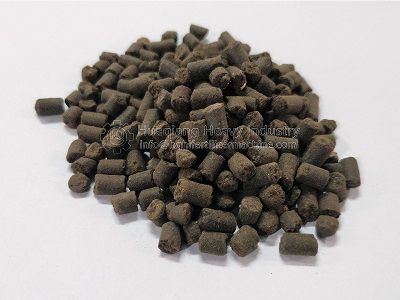
Q1: Why do chicken manure pellets easily clog the die?
The stickiness and moisture content of chicken manure are the two direct causes of die clogging. When the moisture content is higher than 20%, the chicken manure material is soft and sticky, easily forming “plugs” in the die holes during extrusion, leading to die blockage or even stalling. When the moisture content further increases (>35%), “manure juice” will drip from the outlet, directly sealing the die holes. Pure chicken manure itself is highly sticky and lacks a fibrous skeleton, which also exacerbates the adhesion of the material in the die holes. The solution is not to “increase the pressure and force extrusion,” but to reduce the moisture content upon entering the die to the 18%-22% dry processing window, and improve the material structure through auxiliary materials or mushroom residue-like loosening agents.
Q2: If the moisture content after fermentation is 35%, is it necessary to dry it before dry extrusion?
“Drying” isn’t always necessary, but moisture reduction is crucial. A 35% moisture content far exceeds the feed window for dry extrusion, posing a high risk of die blockage if fed directly into the extruder. Possible methods for reducing moisture include extending the aging and turning process, remixing and drying, or adding dehydration equipment; drying is just one method, not the only one. If space and time permit, remixing + aging can gradually reduce moisture without adding heat source equipment, at the cost of a longer fermentation/aging cycle and increased land area.
Q3: What is the moisture window for chicken manure in wet disc granulation?
The suitable moisture content for chicken manure in disc granulation is typically 25%–35%, with the optimal range concentrated between 28%–32%. Above 35%, the pelleting rate decreases significantly, and below 25%, the granules are loose and brittle. Some sources give a wider range of 45%–55% for organic fertilizer disc granulation, but this usually corresponds to a mixture with added additives, not pure chicken manure compost, and should not be used without considering the raw material conditions. For chicken manure as a specific raw material, 28%–32% represents a narrower and safer operating window.