
Sheep manure organic fertilizer production line: Moisture window and granulation
Sheep manure and chicken manure cannot be processed interchangeably. Sheep are ruminants, and their manure has a high fiber content, loose texture, and a moisture content typically between 40% and 55%, a much wider range than chicken manure. This leads to two chain reactions: the fermentation stage requires active water replenishment to start, while the moisture window for the granulation stage is extremely narrow. The key to a sheep manure organic fertilizer production line consistently producing granules lies not in the number of equipment, but in whether the three key stages—fermentation water replenishment, granulation fineness, and granulation moisture content—are precisely controlled.
Fermentation stage: Sheep manure is too dry and requires water addition.
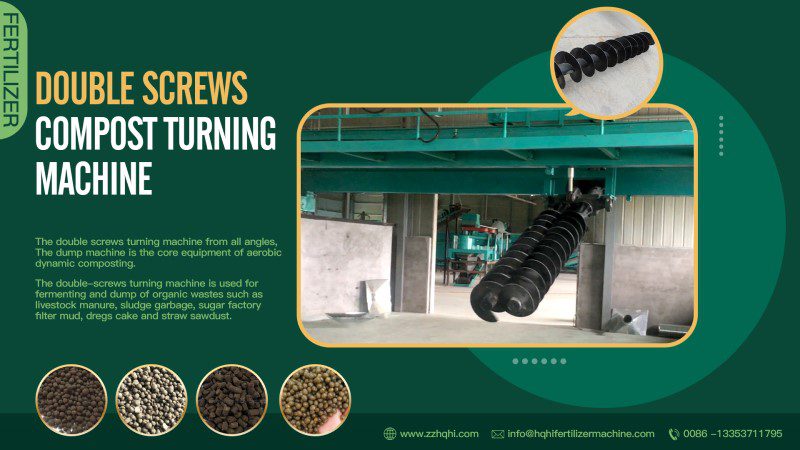
Fresh sheep manure has a low moisture content, theoretically eliminating the need for solid-liquid separation equipment. However, aerobic fermentation itself requires 55%–65% moisture to heat up properly. Directly adding sheep manure to the fermentation tank often results in it being too dry, making it difficult for the compost pile to start composting. The production line should be equipped with an automatic water addition or spraying device, located above the primary mixer, using an online moisture meter to control the moisture content of the mixed material at 58%–62%. When using a double-screw compost turning machine in the turning stage, the width of the sheep manure fermentation tank should be controlled at around 4 meters. It’s not advisable to directly adopt the 6-meter wide tank used for chicken manure—the sheep manure pile is prone to collapse after fiber degradation, and a wide tank actually increases the risk of localized anaerobic digestion.
Crushing Stage: Fiber Entanglement is the First Challenge for Organic Fertilizer Crushers
The residual grass stem fibers in sheep manure can reach 5-15 mm in length, easily causing the screen to clog or the main shaft to become entangled in ordinary screened crushers. After fermentation, the material’s moisture content is still around 30%, and directly feeding it into a hammer mill will frequently cause blockages. A semi-wet material crusher or chain crusher is a better choice: semi-wet models can handle fermented materials with a moisture content of 25%-55%, with a crushing particle size adjustable to 40-60 mesh. The output is loose and does not stick to the walls, providing a uniform powder base for subsequent granulation. Insufficient crushing fineness will prevent particles from “rolling” within the disc, resulting in a significantly lower pelleting rate.
Granulation Section: 28%–32% Moisture Window for Disc Granulator Machines
Sheep manure granulation has a hidden boundary: the optimal moisture content range is very narrow, approximately 28%–32%. Too high a moisture content results in sticking to the discs, clumping, and granule deformation; too low a moisture content makes the material too loose, unable to form a stable core within the disc. Disc granulator machines control particle size through tilt angle and rotation speed, achieving a pelleting rate of over 93% within the ideal moisture window. In actual production, the stable granulation rate of the 30,000-ton/year mixed cow and sheep manure disc granulation project in Shanxi is ≥85%, with particles concentrated between 2–4 mm. This indicates that with controlled moisture and fiber ratios, sheep manure production lines can fully produce commercially viable granulated fertilizer. If the product positioning leans towards powder or low-energy consumption, the roller dry process can bypass drying, but the granule roundness and market acceptance are not as good as the wet disc process.
Judgmentation Order
When encountering problems with sheep manure granulation, check the following order: First, check if the moisture content before granulation is between 28% and 32% → Second, check if the fineness of the granulation reaches 40-60 mesh → Finally, check if the moisture content of the fermentation output varies significantly from batch to batch. Of these three, a breach of the moisture window is the most common cause, often stemming from inadequate water control during fermentation. See the organic fertilizer pulverizer product page for pulverizer parameters, the disc granulator configuration, and the double helix compost turner comparison on the product page.