
Chain Compost Turning Machine: The “Walking Mixer” in Fermentation Trenches
Have you ever seen a steel “track” slowly walking inside a fermentation trench, turning material several meters deep from bottom to top? The chain compost turning machine is such a “strongman”—it uses sturdy chain plates to evenly turn mountains of livestock manure, straw, and sludge, making aerobic fermentation efficient and thorough. It is the core of trough composting systems and a “model worker” on the organic fertilizer production line.
Stepping into a trough fermentation workshop, you see long fermentation trenches filled with composting material. The chain compost turning machine straddles the trench and moves slowly along rails. Its working part is a motor-driven circulating chain plate densely equipped with scrapers or tines. As the machine advances, the chain plate rotates like a track, scraping material from the trench bottom, lifting it, and throwing it backward. This action instantly fluffs the compacted pile, bringing oxygen deep into the material while releasing high-temperature steam and carbon dioxide—one turn equals a thorough “breath exchange.”
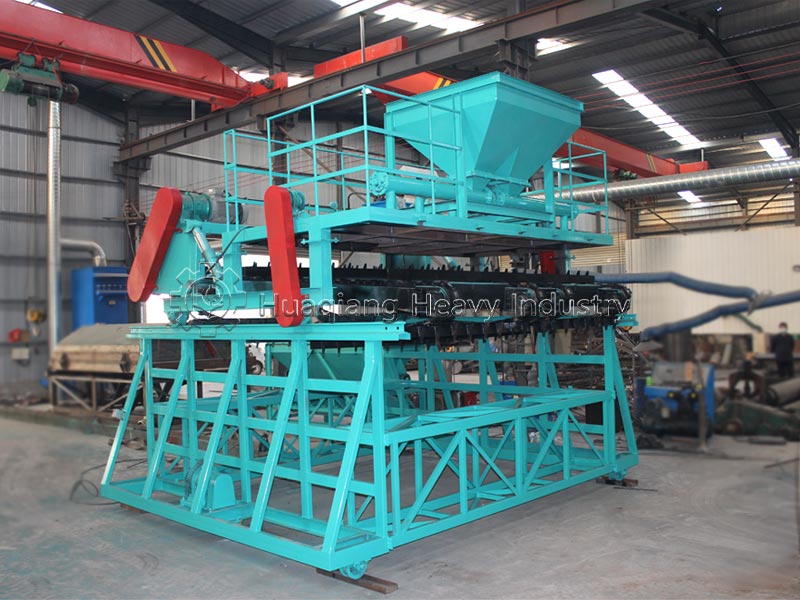
What makes the chain turner unique is its ability to handle extremely deep material layers, typically turning depths of 1.5 to 2.5 meters or even more. Compared to screw-type turners, the chain structure is more robust and durable, less prone to damage from hard objects like stones or sticks. It is especially suitable for treating municipal sludge, household waste, or agricultural residues with high impurity content. Its strong turning capacity and large output—up to hundreds of cubic meters per day—make it the top choice for medium-to-large scale organic fertilizer plants.
In a complete bio-organic fertilizer production line, the chain turner is usually paired with fermentation trenches and a transfer car. By switching rails via the transfer car, one turner can serve multiple trenches—”one machine, multiple trenches”—saving equipment investment. After 15-25 days of high-temperature fermentation, the material is fully decomposed, becoming odorless, loose organic fertilizer feedstock. This decomposed material then proceeds to the next stages: a crusher grinds it fine, a mixer incorporates functional bacteria and nutrients, a disc granulator or rotary drum granulator forms pellets, and finally drying, cooling, screening, and packaging.
Operation and maintenance of the chain turner are relatively simple. Operators only need to set the turning frequency and travel speed, and the machine works automatically back and forth. Routine maintenance mainly involves checking lubrication and wear of chain plates, bearings, and gearboxes, and replacing wear parts promptly. Modern models are also equipped with automatic spray systems to add water or microbial agents during turning, further optimizing the fermentation environment.
During a visit to a large organic fertilizer plant, the manager pointed at the operating chain turner and said with admiration, “It’s like our faithful ox—walking back and forth in the trench from dawn to dusk, never complaining. Without it, we couldn’t handle so much chicken manure.” Indeed, the chain compost turning machine, with its simple chain rotation, supports the stable operation of the entire fermentation process, providing uniform, well-decomposed raw material for subsequent granulation.
So, when you see bags of organic fertilizer being transported to the fields, think of the chain silently moving in the fermentation trench—it transforms waste into fertile soil with strength and patience, nourishing all life.