
What are the differences in pre-treatment for chicken manure, cow manure, and pig manure before granulation?
The core difference in pre-treatment for chicken manure, cow manure, and pig manure before granulation lies not in the name “manure,” but in three physical indicators: moisture content, viscosity, and fiber content. Chicken manure is highly viscous and has a high moisture content, so the focus of pre-treatment is dehydration and anti-sticking. Cow manure has coarse fibers and low viscosity, so the focus of pre-treatment is matching the shearing and granulation methods. Pig manure falls in between, and its pre-treatment is relatively lenient; disc granulation can achieve good cost-effectiveness. The difference in raw material viscosity directly determines the dehydration equipment, crushing method, granulator type, and whether drying is required.
I. Moisture Content, Viscosity, and Recommended Granulation Methods for the Three Types of Manure
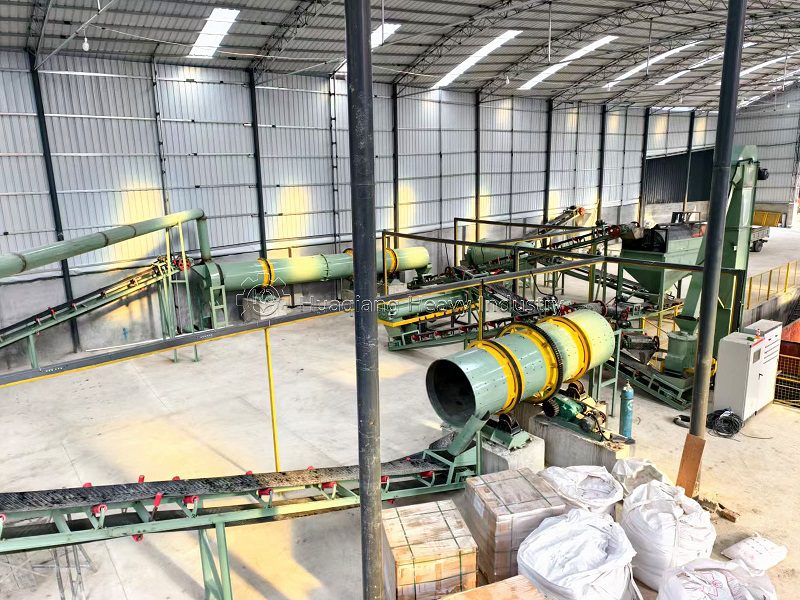
Fermented chicken manure has a fine texture, is rich in nitrogen and humic acid, and has extremely high viscosity. Its moisture content is consistently around 35%, while fresh manure can reach 70%-80%. High viscosity means easy pelletizing, but it easily sticks to equipment and clogs channels. Therefore, a toothed granulator (wet granulation) is the preferred option for chicken manure pellet production lines, with a measured pelletizing rate of up to 95%, and it eliminates the need for drying equipment. However, the surface of chicken manure pellets is prone to becoming damp and white after granulation, requiring a coating machine to remove salt. Pig manure is the next best option, being glutinous with a moisture content mostly between 30% and 38%, often mixed with undigested feed pellets. It has moderate viscosity and is the easiest to pelletize, making disc granulators the most cost-effective option with a moderate drying load. Cow manure is the most unique: it has a high crude fiber content (about 30% to 40%), and the fibers are elastic. After being pressed into pellets, they spring back and disperse when released. After decomposition, its viscosity is significantly reduced, and the pelletizing rate often hovers between 50% and 65%. During roller extrusion, the fibers directly wrap around the roller die holes, easily causing die blockage and machine stalling. The recommended route for cow manure is to first shear and crush it to a sufficient degree, and then use roller extrusion or disc granulation, allowing the short fibers to act as a skeleton to improve pellet strength.
II. Differences in Auxiliary Material Addition Ratios
Chicken manure is already excessively sticky. The role of auxiliary materials is to reduce stickiness and adjust porosity. Commonly used materials include 10%-20% straw powder or rice husks to reduce material adhesion to the equipment’s inner walls and adjust the carbon-nitrogen ratio. Pig manure has moderate stickiness. Auxiliary materials mainly focus on adjusting water content and supplementing carbon sources. The amount of straw or mushroom residue added is adjusted flexibly according to the moisture content. The auxiliary material logic for cow manure is the opposite: cow manure itself has high fiber content and low stickiness. Simply adding straw will make it more difficult to form pellets. Therefore, adding 20%-30% chicken manure or mushroom residue to “increase stickiness and nitrogen content,” or adding 1%-5% bentonite as a binder, is the preferred direction for auxiliary material configuration in cow manure production lines. If a large amount of bedding straw is added to cow manure, it must first be screened through a drum screen to remove uncrushed long fibers for further crushing; otherwise, subsequent parameter adjustments will be ineffective.
III. The Role of Solid-Liquid Separation in Cow Manure Production Lines
Solid-liquid separation is almost standard practice in chicken and pig manure production lines: Small-to-medium-sized chicken manure lines must be equipped with screw extruders for dehydration. Fresh manure is extremely sticky, and without dehydration, it will directly clog the crusher and mixer. After dehydration, the moisture content is reduced to 55%-62%. Pig manure has a moisture content of over 80%, and dehydration is also essential, preferably using a screw press dehydrator; otherwise, black water seepage and environmental risks may occur during the fermentation stage. Cow manure is different: Cow manure has more fiber, and the coarse fiber has a loose structure. Adding 20% straw is enough to reduce the moisture content to the fermentation standard, and not all cow manure lines need a dehydrator. However, when the moisture content of cow manure is high, or when the subsequent process involves roller extrusion, solid-liquid separation changes from an “optional” to a “mandatory” step—roller extrusion requires extremely low moisture content upon entry (usually ≤10%-15%). Without pre-dehydration, drying is necessary; otherwise, the rollers will stick and clog the mold. In cow manure production lines, the placement for solid-liquid separation should be done before fermentation or before granulation, depending on the final granulation route: For wet disc granulation, water can be added after fermentation; for dry roller granulation, dehydration or drying is necessary after fermentation and before granulation.
IV. FAQ: Can pig manure and chicken manure production lines share equipment?
Q: I already have a chicken manure organic fertilizer production line and now want to process pig manure. Can the equipment be directly shared?
A: Partial sharing is feasible, but the core granulation section needs evaluation. Screening, cooling, packaging, and conveying equipment are basically interchangeable; dehydration equipment and fermentation turning equipment also have high compatibility between chicken and pig manure (both require dehydration, and the turning method can be slightly adjusted according to viscosity). The real difference lies in the granulation section: chicken manure is extremely viscous, so a toothed granulator is the preferred option; pig manure has moderate viscosity, so a disc granulator offers the best cost-effectiveness. If a chicken manure production line already uses a toothed granulator, it can usually operate on pig manure as well, but it’s necessary to confirm whether undigested feed particles in the pig manure will cause abrasion. If the chicken manure line uses a disc granulator, switching to pig manure processing is relatively easier, as disc granulators are well-suited to pig manure. The differences in the crushing section are significant: chicken manure requires an anti-stick cage-type or semi-wet crusher, while pig manure can use a twin-shaft semi-wet crusher to focus on breaking up clumps. The two are not entirely interchangeable in terms of blade assembly and anti-sticking design. Using shared equipment requires first measuring the moisture content and viscosity of the pig manure to determine if the granulation and crushing sections need localized modification, rather than directly applying the parameters of the chicken manure line to pig manure.
V. Cross-Process Integration and Equipment Selection
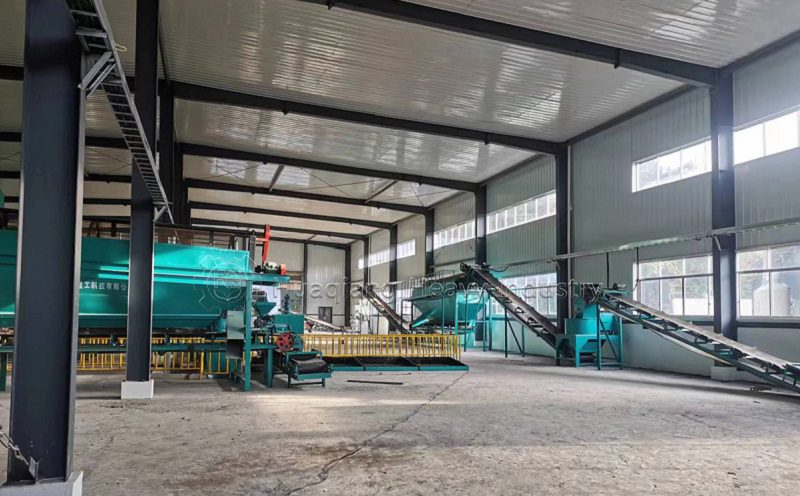
These pre-treatment principles should be applied at the level of the whole process chain rather than to individual machines. When configuring a chicken manure organic fertilizer production process or a poultry manure fertilizer production process, the same moisture, viscosity, and fiber assessment should guide the selection of an animal manure processing machine, especially the dehydrator, crusher, and granulator combination. For a pig manure fertilizer production process, moderate viscosity makes disc granulation a cost-effective default, while a cow manure production line requires fiber shearing and, where roller extrusion is used, stricter moisture control through optional solid-liquid separation. In this way, equipment selection follows material properties instead of being copied from one manure type to another.
The pre-treatment of the three types of manure for granulation essentially involves positioning them separately along two axes: viscosity and fiber. Chicken manure falls at the “high viscosity” end, requiring subtraction in pretreatment—dehydration to reduce viscosity and agitation to form pellets; cow manure falls at the “high fiber, low viscosity” end, requiring addition and shearing in pretreatment—adding viscosity-enhancing additives and shortening fibers; pig manure is in the middle, with disc granulation achieving a stable pelleting rate at the lowest possible technological cost. By accurately measuring the three indicators of moisture, viscosity, and fiber, and then applying them to the dehydration and granulation equipment, the pretreatment process will avoid unnecessary detours.