
Drum Fertilizer Dryer: Innovative Specialized Equipment for Dehydrating and Upgrading Organic Fertilizer Granules
The drying stage following granulation directly determines the finished product’s moisture content, granule strength, and nutrient retention. Traditional drying equipment typically suffers from four major issues: material sticking and clumping, nutrient deactivation due to high temperatures, uneven drying, and high energy consumption. Based on heat and mass transfer theory, this new rotary fertilizer dryer features innovations in both its structural design and control system; it serves as core, integrated equipment for dehydrating and upgrading various types of organic fertilizer granules, simultaneously achieving efficient drying and enhanced fertilizer quality.
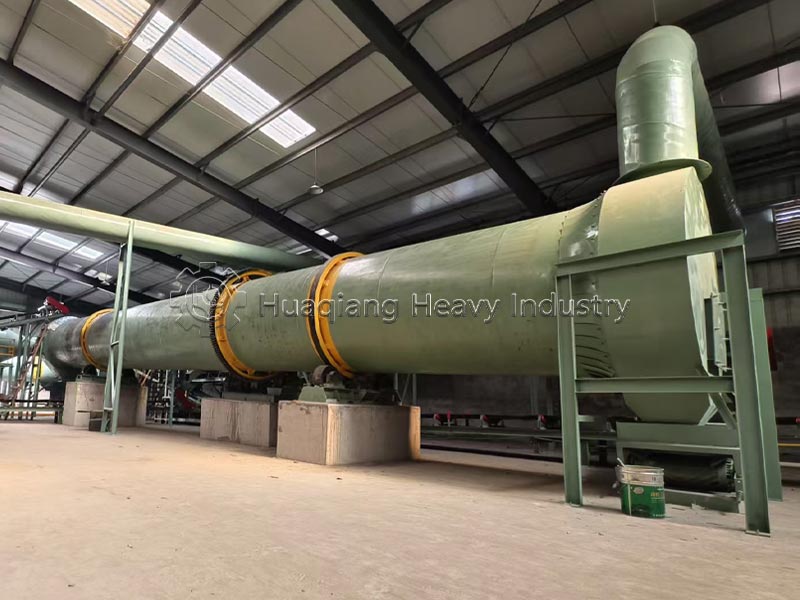
Drum fertilizer dryer‘s core innovations span three technical areas, with a theoretical design perfectly aligned to the material properties of organic fertilizer. First is the sectional, low-temperature controlled drying structure. Based on the heat tolerance thresholds of organic matter and beneficial bacteria, the drum interior is divided into three temperature zones: preheating, main drying, and quality stabilization. The preheating zone (40–60°C) gently removes surface moisture, preventing the outer shell from hardening and trapping internal vapor. The main drying zone utilizes stable, low-temperature hot air (60–75°C) for heat exchange, strictly limiting the material’s core temperature to below 65°C to maximize the retention of nitrogen, humus, and functional live bacteria; the retention rate of organic matter in the finished product exceeds 90%. Second is the combination of multi-layer, curved lifting flights with an elastic self-cleaning mechanism. Moving away from simple flat lifting plates, the system employs curved lifting components with varying angles to create a suspended curtain of granules, thereby increasing the heat exchange surface area. Additionally, built-in spring-loaded scraper strips dynamically clean material adhering to the drum walls, solving the problem of high-moisture granule agglomeration and boosting the granule integrity rate after drying to 97%. The third component is an intelligent control system for closed-loop waste heat recovery. Equipped with dual-sensor modules for real-time moisture and temperature monitoring, it coordinates variable-frequency fans with the drum’s speed-control mechanism to automatically adjust hot air volume and drum retention time based on the feed’s moisture content. Exhaust gases pass through a heat exchanger to preheat incoming cold air, reducing overall energy consumption by 28% compared to traditional models. The moisture content of the output is stably maintained within the 12%–18% range, meeting national standards for organic fertilizer storage.
Regarding process logic, wet granules are fed at a constant rate into an inclined drum, where lifting flights guide them in a steady, spiral downward motion, ensuring full contact with counter-current low-temperature hot air for effective moisture removal. An internal, gentle breaking mechanism loosens clumped granules without violent impact, thereby minimizing breakage. At the discharge end, cooling and stabilization occur simultaneously; high-temperature granules are rapidly cooled to below 40°C, preventing post-packaging issues such as moisture re-absorption, caking, and nutrient loss. The entire process operates continuously within a sealed system equipped with dust and odor removal units, balancing production efficiency with environmental compliance. It is suitable for organic fertilizer granules made from diverse raw materials—such as livestock manure, crop straw, and spent mushroom substrate—and can be integrated into small, medium, and large-scale production lines.
This innovative drum dryer moves beyond the traditional focus on mere dehydration speed. By prioritizing quality enhancement, it optimizes heat transfer structures, temperature control systems, and self-cleaning mechanisms. It simultaneously addresses the needs for energy conservation, nutrient preservation, and breakage prevention, effectively solving common industry challenges in organic fertilizer granule processing and providing a stable, reliable solution for large-scale, standardized production.