
【FAQ】Fertilizer Production Technology and Process – What is the Basic Process of Organic Fertilizer Production?
What is the basic process of organic fertilizer production?
The standardized process of organic fertilizer production can be summarized into eight core steps: raw material fermentation → material crushing → ingredient mixing → granulation → drying and cooling → screening → coating → packaging. These eight steps constitute a complete transformation chain from organic waste to commercial organic fertilizer, and each step plays a crucial role in the quality and yield of the final product.
- Raw Material Fermentation (Composting)
This step is the foundation and core of organic fertilizer production. Livestock manure, crop straw, and mushroom residue are mixed with fermentation agents in a specific ratio. The mixture is periodically turned and aerated using a compost turner, controlling the compost temperature between 55℃ and 65℃. After 15–20 days of aerobic fermentation, the organic materials are fully decomposed. The signs of mature fermentation are a dark brown color, no foul odor, loose and non-clumping material, and a moisture content reduced to approximately 40%. The main equipment at this stage is the compost turner and aeration system.
- Material Crushing
Fermented materials often exhibit large clumps, requiring crushing. This step pulverizes the large clumps into a fine powder of 20-80 mesh, providing a uniform particle size base for subsequent mixing and granulation. Commonly used crushing equipment includes semi-wet material crushers and vertical roller crushers.
III. Ingredient Mixing
According to the product formula, the crushed fermented material is precisely mixed with inorganic nutrients such as nitrogen, phosphorus, and potassium, as well as trace elements, in precise proportions. This step utilizes an automatic batching system and horizontal/vertical mixers to achieve thorough and uniform mixing, ensuring consistent nutrient content in each batch.
- Granulation
The uniformly mixed powdered material is processed into granules. Depending on the raw material characteristics and production scale, different models such as disc granulators, rotary drum granulators, or double-roll extrusion granulators can be selected. Granule shapes can be spherical, oblate, or rod-shaped. This step significantly improves the physical properties of the fertilizer, facilitating storage, transportation, and mechanized application.
- Drying and Cooling Freshly granulated granules have a high moisture content (15%–25%), which needs to be reduced to below 10% using a dryer to ensure granule strength and prevent mold growth. They are then cooled to slightly above room temperature using a cooler to prevent internal moisture condensation and subsequent pulverization after packaging. The heat source for drying can be biomass, natural gas, or coal.
- Screening The cooled granules are graded using a vibrating screen. Qualified granules (typically 2–5 mm in diameter) proceed to the next stage. Oversized granules are returned to the granulation process via a crusher, while excessively fine powder is returned to the batching system for reuse, achieving a closed-loop production cycle and reducing raw material waste.
VII. Coating (Optional) A coating agent or anti-caking agent is applied to the surface of the finished granules. This step effectively prevents the granules from absorbing moisture and clumping during storage. Functional microbial agents or slow-release materials can also be added to increase the product’s added value.
VIII. Packaging
Finally, the qualified finished granules are quantitatively packaged using an automated packaging and weighing system (common sizes are 5kg, 10kg, 25kg, and 50kg), sealed, and then stacked and stored. Modern packaging systems offer high precision, speed, and data traceability.
In summary, the entire organic fertilizer production process is interconnected, and each step requires strict control of process parameters. Depending on the raw materials and product positioning, some steps (such as coating) can be omitted as needed, but the core chain of “fermentation – granulation – drying – screening – packaging” is common to the vast majority of commercial organic fertilizer production lines.
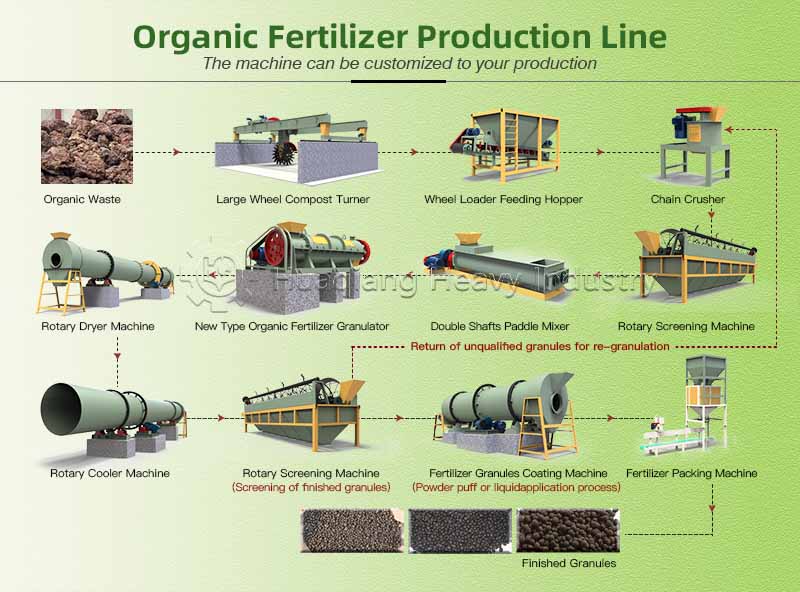
From Waste to Value – The Complete Organic Fertilizer Journey
Understanding the organic fertilizer production process is not merely about memorizing eight sequential steps—it is about orchestrating a balanced system where each unit interacts with the next. For a commercial organic fertilizer production line, the real challenge lies in harmonizing fermentation dynamics with mechanical efficiency. This is where organic fertilizer plant design and layout becomes critical: a well‑planned workshop minimizes material handling, optimizes heat recovery from drying, and ensures dust control, directly impacting product cost and consistency.
Moreover, modern producers often adopt the organic fertilizer combined granulation process, which integrates disc granulation with extrusion or drum granulation, allowing flexible production of both spherical and cylindrical granules from the same feedstock. For clients who require rapid soil incorporation or liquid blending, a dedicated powdered organic fertilizer production line can bypass the granulation and drying stages, delivering fine, flowable powder with high humic acid content—offering a low‑investment, fast‑payback alternative.
In essence, every production route—whether granulated or powdered, basic or multi‑functional—stems from the same core process logic: ferment to stabilize, grind to homogenize, form to handle, and dry to preserve. As environmental regulations tighten and the demand for high‑quality organic amendments grows, the industry is moving toward smarter automation, real‑time moisture control, and modular plant designs. Ultimately, a well‑executed organic fertilizer production system is not just a manufacturing line—it is a sustainable biorefinery that turns waste into wealth, while safeguarding soil health for generations to come.