
Fertilizer Granule Market Trends: Large Particles or Slow Release? Granulation Lines and Coating Technology
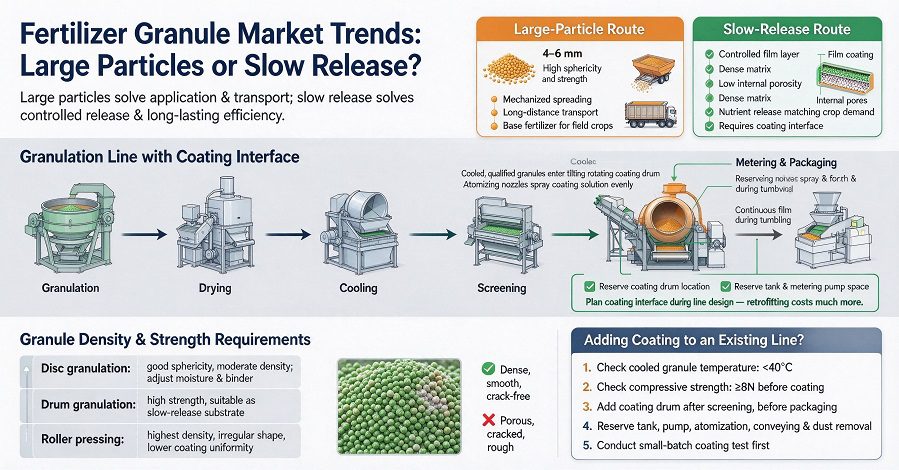
The fertilizer granule market is diverging along two paths: one towards large particles and high strength, serving mechanized fertilization and long-distance transportation; the other towards slow-release and controlled-release, relying on coating technology rather than simple granulation. The core conclusion is: large particles solve the problem of “easy application and transport,” while slow-release solves the problem of “accurate release and long-lasting fertilizer effect.” Granulation line design should reserve interfaces for coating sections, rather than adding them afterward.
I. The Correspondence Between Particle Size, Strength, and Fertilization Methods
The particle size and strength of fertilizer granules are primarily determined by the fertilization method. Mechanical spreading requires granules with good flowability and uniform size; typically 2–4 mm spherical granules are ideal. Granules that are too small are prone to scattering, while those that are too large result in uneven spreading. Seed-fertilizer co-sowing requires even higher granule strength; compressive strength generally needs to reach 8 N or higher, otherwise granules are prone to breakage in the seed metering pipe. In long-distance transportation and multiple transshipment scenarios, insufficient particle strength will significantly increase the pulverization rate; a powder content exceeding 5% in the finished product will affect the selling price.
Large-particle fertilizers (4–6 mm in diameter) have significant advantages in mechanized fertilization: larger single-particle weight, longer spreading distance, and more uniform coverage, making them suitable for base fertilizer in field crops. However, large particles place higher demands on the molds and processes of granulation equipment. Disc granulation requires larger disc diameters and inclination angles, while drum granulation requires longer residence time. In terms of strength, roller-pressed granules have high density but irregular shapes, while disc and drum granules have good sphericity but moderate strength; the choice must be made based on the application scenario.
II. The Position of Coating Process in the Flowchart
The coating process in a granular fertilizer production line is typically after screening and before packaging. A typical flow is: granulation, drying, cooling, screening, coating, and metering/packaging. The core equipment in the coating section is the coating drum (rotary coating machine). Cooled, qualified granules enter the tilting, rotating coating drum, where the coating solution is evenly sprayed through atomizing nozzles. The granules form a continuous film layer during tumbling.
A key point is that the coating section is not an isolated process; it relies on the stability of the upstream granulation and cooling processes. If the granule temperature is too high, the coating solution evaporates too quickly, resulting in uneven film formation; excessive dust on the granule surface leads to poor film adhesion; insufficient granule strength causes fragmentation during tumbling, clogging the nozzles. Therefore, interfaces for the coating section should be reserved during the granulation line design phase — including the installation location of the coating drum, space for the coating solution storage tank and metering pump, and the conveying path for the finished coated product. Adding it later is often limited by plant height and process layout, and the cost of modification is far higher than pre-planning.
III. Requirements for Granule Density in Slow-Release Products
The release rate of slow-release fertilizers depends on the integrity of the film layer and the density of the granule matrix. When particle density is insufficient, there are many internal pores, allowing moisture to easily penetrate and nutrients to be released too quickly, significantly reducing the slow-release effect. Therefore, slow-release products place higher demands on the granulation process: particles must be dense, with smooth surfaces, free of cracks, a sphericity of no less than 0.85, and a compressive strength typically above 10 N.
This, in turn, affects the choice of granulation process. Disc granulation produces particles with good sphericity but moderate density, requiring adjustments to moisture and binders to improve density; drum granulation produces high-strength particles, suitable as slow-release substrates; roller pressing produces the highest density, but with irregular shapes and poor coating uniformity. The choice of which route to take depends on the target release period of the slow-release product and the characteristics of the coating material.
IV. FAQ: What Needs to Be Modified to Add Coating to an Existing Line?
Q: I already have a granulation line and want to add a coating section. What aspects need to be modified?
First, confirm whether the temperature and strength of the cooled particles meet the standards — the particle temperature should be reduced to below 40°C, and the compressive strength should be no less than 8 N; otherwise, the cooling and granulation parameters need to be optimized first. Secondly, after the screening machine and before the packaging machine, add a coating drum and a matching coating liquid storage tank, metering pump, and atomization system, and reserve interfaces for finished product conveying and dust removal. If the plant height is insufficient, the coating drum can be arranged in a low position with an elevator. Before the modification, it is recommended to conduct coating tests with a small batch of granules to confirm the film adhesion and release curve before finalizing the plan.