
Loader Feeding Hopper: Why Is It the “Smart Gateway” to Fertilizer Production?
In modern organic fertilizer production lines, the feeding stage is often likened to the system’s “throat.” When faced with various options like traditional manual feeding, belt conveyors, and the innovative loader feeding hopper, have you ever wondered: which truly combines efficiency and intelligence? The loader feeding hopper—this seemingly simple “material gatekeeper”—is redefining feeding standards with its outstanding performance.
The advantages of the loader feeding hopper unfold like a well-orchestrated symphony, each note singing of efficiency. First, leap in efficiency: it easily handles tons of raw materials, transforming each loader operation into continuous production power, with hourly throughput up to ten times that of manual feeding. Second, labor liberation: automated design allows two workers to accomplish tasks that previously required six, completely freeing manpower from heavy lifting. Moreover, precise control: paired with advanced metering systems, it proportions ingredients with the precision of a Michelin chef, ensuring recipe consistency. Finally, exceptional adaptability: whether dealing with crushed straw, moist manure, or mixed compost, it handles all with ease, truly the “Transformer” of raw material processing.
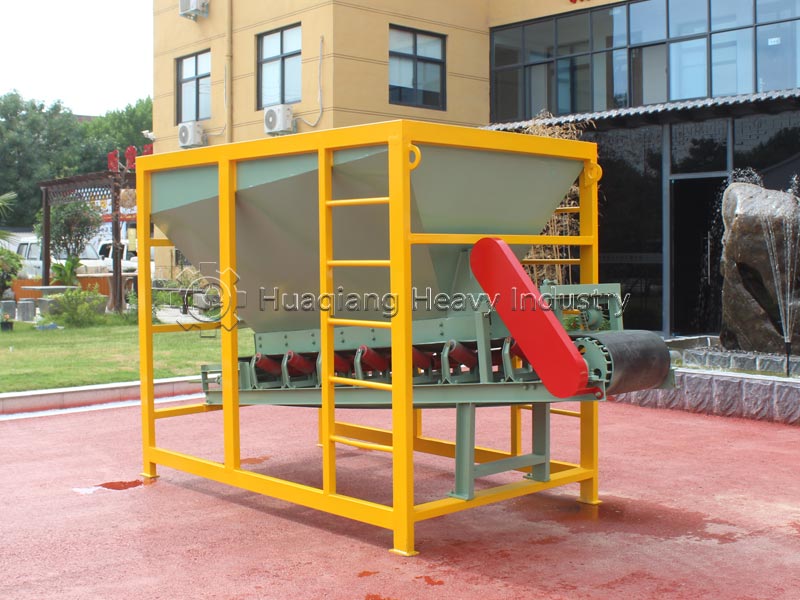
Compared to traditional equipment, its superiority is evident. Manual feeding, while low in initial cost, is inefficient and labor-intensive, akin to “returning to the agrarian era.” Belt conveyor offer continuous operation but lack flexibility and precision, occupying significant space.Screw conveyor suitable for powdered material transport, but prone to clogging with wet and sticky raw materials, high maintenance frequency, and relatively high energy consumption.
In contrast, the loader feeding hopper ingeniously blends the loader’s mobility with specialized equipment’s accuracy, striking the perfect balance between efficiency and cost—it acts like an intelligent traffic controller, ensuring seamless transition of materials from storage to production line.
Choosing the loader feeding hopper is justified by solid reasons: Economically, it dramatically reduces labor costs, improves equipment utilization, and shortens the return on investment period significantly. Qualitatively, it ensures uniform material supply, prevents production fluctuations, and guarantees final product consistency. Environmentally, it enables enclosed conveyance, reducing dust emissions and improving the work environment. Strategically, it paves the way for automation and intelligent transformation. This is not merely an equipment upgrade but the key to a production efficiency revolution.
In summary, with its comprehensive advantages of efficiency, intelligence, and reliability, the loader feeding hopper is becoming standard in modern fertilizer production. Choosing it means choosing a smart path toward efficient production and sustainable development.