
Rotary Drum Granulator: The “Behemoth” of Fertilizer Industry?
How It Works — Wet-Granulation “Drum Magic”
The rotary drum granulator is the undisputed workhorse for large-scale compound fertilizer, organic fertilizer, and large-granule urea production. It operates on the agglomeration wet-granulation principle: material enters an inclined, rotating cylinder while steam or liquid binder is sprayed in. Under liquid-phase conditions, the tumbling motion forces particles to collide, squeeze, and coalesce—like snowballs growing from fines into dense, spherical granules.
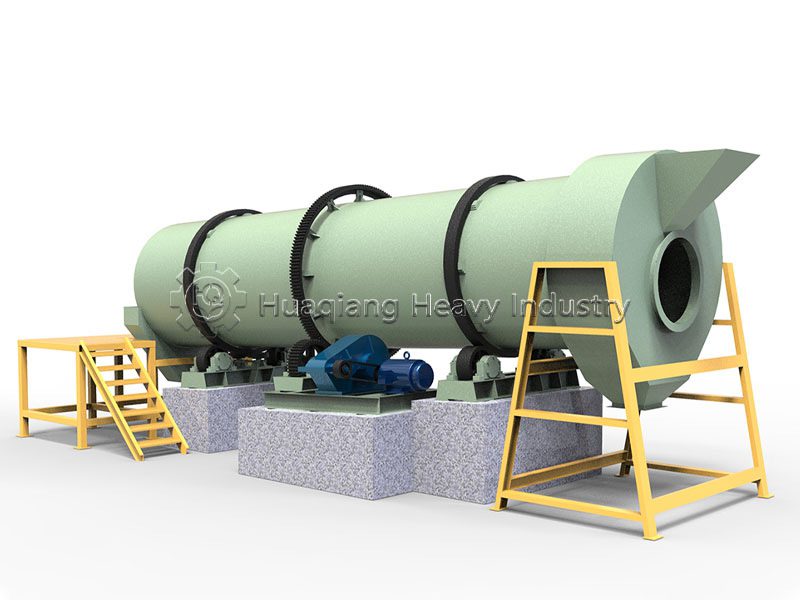
This isn‘t merely physical rolling. For NPK blends, ammonia gas, phosphoric acid, or slurries can be injected directly into the drum, enabling simultaneous chemical reaction and heat transfer. It’s a granulator and a chemical reactor in one.
From an engineer’s notebook: Drum granulation is a subtype of “agitation agglomeration.” Retention time can be tuned from 30 seconds to 60 minutes. By adjusting rotation speed, slope, moisture, and steam flow, you gain precise control over pellet size and hardness. Its superpower is never “delicacy”—it‘s “volume.”
Anatomy of a Steel Giant — Core Structure
Shell & Liner
Welded from high-quality carbon steel plates. The game-changer: rubber or acid resistant stainless steel liners that provide “selfremoval of scars and lumps”—completely eliminating traditional scrapers. Anticorrosion, thermal insulation, and no buildup.
Support Base & Riding Rings
The entire weight rests on the support base. Trunnion wheels are made of special wearresistant alloy; riding rings are fixed to both ends of the drum. Onepiece cast base with lifting hooks for easy transport and installation.
Data compiled from multiple manufacturers; larger scales (custom >100 t/h) available.
Drum vs. Disc: Not Even the Same League
Drum Granulator
Throughput King: 100+ t/h easily, disc cannot compete.
Closed system: Minimal fugitive dust, cleaner workshop.
Thermal/chemical compatible: Steam, ammonia, slurry direct injection.
Selfcleaning liner, no scraper.
Rounder, more uniform pellets — “looks” win.
Lower entry cost, ideal for smallbatch, multispec.
Open design, realtime observation.
Capacity capped far below drum.
Verdict: For ultimate capacity and continuous mass production, drum is the only answer.
Never Works Alone — Role in the Production Line
A drum granulator must be paired with a dryer, cooler, screens, and a recycle system. The typical balling rate is ~70%; undersize and crushed oversize are returned to the drum. This closed loop design minimizes waste and maximizes efficiency.
Special Mission: Large Urea Disruptor
Conventional prilling towers produce small, lowstrength urea pellets that tend to powder during transport. Drum granulation delivers the perfect fix: 2–8mm large urea granules with crushing strength ≥27N — 5X stronger than prilled! Less dust, no caking, higher market price.
China already operates 200 kt/a plants with payback periods as short as 12 months—a “golden upgrade” for existing urea facilities.
Maintenance Commandments
Gear/Riding rings: Apply dry grease before startup; regrease riding rings every 7 days; inspect gears daily.
Bearings: Replace dry grease every 3 months; stop immediately if temperature rises abnormally.
Reducer: Fill with gear oil before first use, then change every 4 months.
Liners: “Selfcleaning” doesn‘t mean no inspection—check wear regularly, especially with corrosive materials.
Intelligence: A Neural Network for the Beast
Today‘s drum granulators are far from “dumb iron.” PLC autocontrol, VFD, online moisture/temperature sensors are standard. Pioneering lines now use digital twins to model pellet growth curves, adjusting spray and speed in real time. Maintenance evolves from “fixwhenbroken” to predictive—sensors monitor bearing vibration and gear temperature, alerting before failure.
Does a drum granulator require a recycle circuit?
Absolutely recommended. Recycling fines not only stabilizes operation but also lowers inlet moisture, enabling efficient continuous production. Pros call it “back mixing.”
What materials are NOT suitable?
Highly sticky, watersoluble, or extremely heatsensitive materials need caution. However, most can be handled with proper pretreatment (predrying, premixing).
From millionton NPK complexes to midsize organic fertilizer plants, the drum granulator dominates thanks to its immense rawmaterial flexibility and almost unlimited scaleup potential.
The “Behemoth” of Industrial Granulation
Without the rotary drum granulator, there would be no millionton compound fertilizer industry. It isn‘t delicate, but it’s indomitable; it‘s massive, yet precisely engineered. From farmscale composting to worldscale chemical giants, the drum—with its humble tumbling philosophy—props up the backbone of green agriculture.