
The Chain Compost Turning Machine: It Doesn’t Just Turn. It Flings.
Walk past a traditional compost row, and what do you see? A tractor with a front-end loader, pushing, shoveling, struggling. The pile gets moved, sure. But turned? Not really. The bottom stays wet. The top stays dry. The middle stays compacted. And somewhere in between, anaerobic pockets breed the smell that makes neighbors complain.
Now walk past a chain compost turning machine. The difference hits you before you see it—the rhythmic clatter of chains, the shower of material flying through the air, the complete absence of that rotten-egg stench. This machine doesn’t push compost. It throws it.
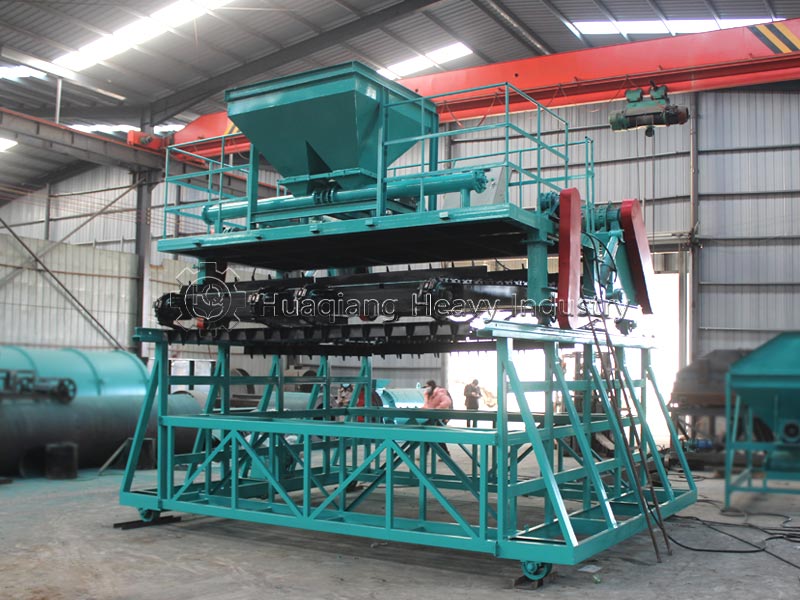
What Is a Chain Compost Turner?
Imagine a belt conveyor, but instead of carrying material gently, it’s armed with heavy-duty chains mounted on rotating shafts. The machine sits inside a narrow trough or straddles a windrow. As the chains spin, they dig deep into the pile, lift material, and fling it backward through the air.
Every particle gets airborne. Every clump gets broken. Every inch gets oxygen.
Why Chains? Why Not Paddles or Augers?
Good question. Chains do something no rigid tool can: they flex. When a chain hits a rock or a tough lump, it gives slightly, then snaps back. Less breakage. Less jamming. Less stress on the machine.
And because chains are open, they don’t carry material around with them. Sticky stuff? Wet manure? Long fibrous straw? The chains slap through it, toss it, and come back clean. No wrapping. No clogging. No midnight cleaning sessions.
The Trough System: A Different Way to Compost
Most chain turners work in a groove—literally. You build concrete or steel troughs, long and narrow, and fill them with organic material. The chain turner runs on rails along the top, moving slowly down the trough, turning as it goes.
This design changes everything:
Space efficiency – Troughs pack more compost into less footprint
Odor control – The trough contains the material; exhaust systems can capture air right at the source
Process control – You know exactly how many turns each batch gets
Year-round operation – Cover the troughs with a roof, and rain or snow doesn’t stop you
Continuous vs. Batch
Chain turners handle both styles.
In batch mode, you fill a trough, turn it regularly until finished, then empty and start over. Perfect for specialty composts where each batch needs its own schedule.
In continuous mode, you add fresh material at one end every day, and the turner moves it slowly toward the discharge end. By the time it reaches the end, it’s finished compost. No waiting. No stopping. Just steady production.
The Aeration Obsession
Composting is microbial respiration. Billions of tiny organisms breathing oxygen and exhaling carbon dioxide. Without oxygen, they suffocate. The pile goes anaerobic. The smell turns foul. The process stalls.
The chain compost turner solves this by turning compost into a projectile. When chains fling material through the air, every particle gets wrapped in oxygen. The pile that lands behind the machine is loose, fluffy, and ready for microbes to feast.
Temperature soars. Decomposition accelerates. And the odors that drive neighbors crazy? Gone.
What It Handles
This machine isn’t picky:
Manure with bedding – straw, sawdust, wood chips—the chains shred it all
Crop residues – corn stalks, wheat straw, grape pomace
Food waste – from processing plants or commercial kitchens
Municipal sludge – mixed with bulking agents
Green waste – leaves, grass, branches (pre-shredded)
If it’s organic and needs composting, the chain turner takes it.