
The Heartbeat of the Line: How the Chain Compost Turner Powers Bio-Organic Fertilizer Production
Walk into any modern organic fertilizer plant, and you’ll hear it before you see it. The rhythmic clank of steel plates, the quiet hum of motors, the steady churning of material being lifted and tossed. At the center of it all sits the chain compost turner—not always the most glamorous machine in the lineup, but arguably the most important. Without it, the entire production line grinds to a halt.
The Forgotten Hero of Fermentation
Here’s the truth about bio-organic fertilizer: it all starts with fermentation. You can have the most sophisticated granulator on the market, the sleekest packaging line, the most precise screening system—but if your raw material isn’t properly composted, nothing else matters. The product will fail. The smell will linger. The pathogens will survive.
That’s why the chain compost turner deserves center stage in any serious operation.
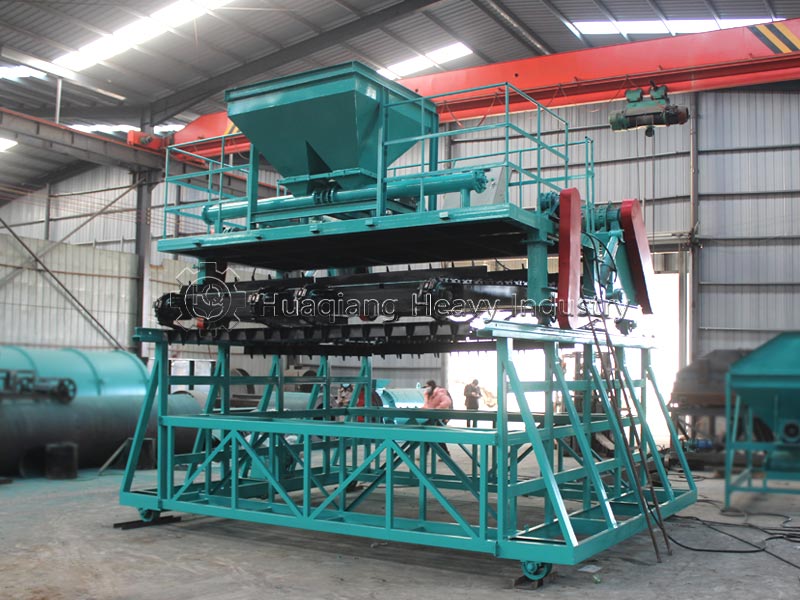
Picture this: long, concrete fermentation troughs stretching across the facility, filled deep with raw organic waste—chicken manure, cow dung, crop straw, mushroom residue. It’s heavy, wet, and packed with potential. But left untouched, it turns anaerobic, sour, and useless. The chain compost turner straddles these troughs, running on rails mounted on the walls, and gets to work.
How the Chain Works Its Magic
The design is beautifully simple. A massive frame spans the width of the trough. Suspended from it, a continuous loop of heavy-duty chain fitted with steel plates reaches down into the material. As the machine travels slowly forward, the chain rotates continuously, scooping material from the bottom, lifting it vertically, and releasing it in a cascading shower at the top.
Why does this matter? Because depth matters. While other turners skim the surface, the chain design reaches deep—up to two meters or more. Every particle, from the top to the very bottom of the trough, gets its moment in the air. Oxygen floods the pile. Temperatures soar high enough to kill weed seeds and pathogens. Moisture redistributes evenly. Anaerobic pockets simply cease to exist.
And here’s a feature that separates the professionals from the amateurs: many chain turners come equipped with bacterial liquid spray systems. As the machine turns, it can simultaneously inoculate the material with beneficial microbes—two critical jobs in one pass, ensuring consistent biological activity throughout the pile.
From Compost to Granules: The Two-In-One Revolution
Now, let’s talk about what happens after the chain compost turner finishes its work. You’ve got beautiful, stable compost—dark, crumbly, sweet-smelling, packed with humus and beneficial microorganisms. But for most markets, especially commercial agriculture, powder won’t cut it. Buyers want granules. Uniform, round, easy-to-spread granules that won’t clog equipment and release nutrients slowly.
Enter the new type two-in-one organic fertilizer granulator, the perfect partner to the chain compost turner.
This machine represents a significant leap forward in granulation technology. It combines two distinct granulation methods—stirring tooth granulation and rotary drum granulation—into a single, efficient unit. Here’s how it works: material enters the first granulation section, where high-speed rotating mixing knives prepare it for shaping. Then it’s pushed to the second section, where internal mixing teeth complete the granulation process while the outer cylinder molds the particles into their final form.
The results speak for themselves. Granulation rates can exceed well over ninety percent, meaning almost everything that goes in comes out as usable product. The granules are spherical, uniform in size, and possess excellent strength—significantly better than what you’d get from a disc granulator. And because the design handles coarse fiber materials that stump conventional equipment—things like crop straw, wine residue, and drug residue—it pairs perfectly with the diverse feedstocks that come out of your fermentation troughs.
The Complete Picture: A Bio-Organic Fertilizer Production Line
Now step back and look at the whole operation. The chain compost turner handles the front end—transforming raw waste into stable, pathogen-free compost. The two-in-one granulator takes over from there, turning that compost into premium, market-ready pellets. But between them and around them, a supporting cast ensures everything runs smoothly.
Before fermentation, you might need a pre-crusher to break down large clumps or a solid-liquid separator if you’re dealing with particularly wet manure. After fermentation, a half-wet material crusher reduces particle size for consistent granulation. A mixer ensures any additional ingredients—other organic materials, beneficial microbes, trace elements—are evenly distributed.
After granulation, a dryer and cooler bring moisture down to ideal levels and stabilize the pellets. A screening machine separates oversized granules (which get crushed and recycled) from on-spec product. A coating machine can apply a protective layer to prevent caking and enhance appearance. And finally, an automatic packaging scale fills bags with precision, ready for palletizing and shipment.