
1–5 T/H Complete Organic Fertilizer Plant: Investment and Operation Guide
A 1–5 T/H complete organic fertilizer plant is the perfect choice for medium-scale producers looking to expand their business or upgrade from small-scale operations. This capacity balances productivity and cost-effectiveness, capable of processing large volumes of organic raw materials (such as livestock manure, crop straw, and municipal organic waste) into high-value organic fertilizer, meeting the growing demand for eco-friendly agriculture. However, building and operating such a plant requires careful planning—from investment budgeting to daily operation. This guide breaks down the key investment considerations and practical operation tips to help you run a profitable and efficient organic fertilizer plant.
First, let’s clarify the investment budget, which is the core concern for most producers. The total investment for a 1–5 T/H complete organic fertilizer plant ranges from $50,000 to $150,000, depending on equipment quality, configuration, and workshop conditions. The largest expense is the complete set of equipment, accounting for 60%–70% of the total investment. Huaqiang, a professional organic fertilizer equipment manufacturer, offers tailored equipment packages for this capacity, including core machines and supporting facilities.
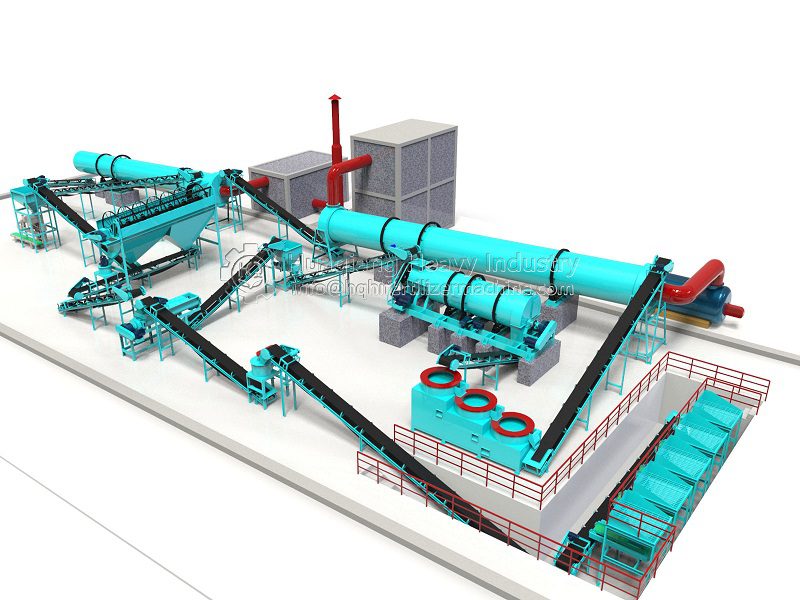
The key equipment investment includes: fermentation equipment (crawler-type compost turner for large-scale fermentation), preprocessing equipment (half-wet material crusher and high-efficiency mixer), granulation equipment (rotary drum granulator or double roller press granulator for continuous production), drying/cooling equipment (rotary dryer and cooler), screening/packaging equipment (circular screener and automatic packing machine), and auxiliary facilities (conveyors, batching system). Additionally, budget for workshop renovation (ventilation, drainage), raw material storage, and labor costs (3–5 workers per shift).
When it comes to operation, efficiency and product quality are the top priorities. Start with raw material management: ensure raw materials are fermented thoroughly (7–15 days) using microbial agents, as incomplete fermentation will affect fertilizer quality and cause odor pollution. Control the moisture content of fermented materials at 40%–50% before granulation to improve granulation rate and particle uniformity.
Daily equipment operation tips: Conduct no-load inspections before starting the production line to check for abnormal noise or loose parts. Adjust granulation parameters (such as pressure and feed speed) according to raw material characteristics to ensure consistent particle size. Regularly clean and maintain equipment—lubricate rotating parts, replace worn screens or dies, and remove residual materials to extend service life and reduce downtime. Implement a quality control system to test fertilizer nutrient content and moisture regularly, ensuring compliance with industry standards.
Cost control is also crucial for profitability. Optimize raw material sourcing by cooperating with local farms or waste treatment plants to reduce raw material costs. Improve energy efficiency by using energy-saving equipment and optimizing production processes (e.g., using waste heat from drying for preheating). Train workers to operate equipment proficiently to avoid operational errors and material waste.
In summary, a 1–5 T/H complete organic fertilizer plant offers great profit potential with proper investment planning and scientific operation. By choosing high-quality equipment, managing raw materials effectively, and optimizing daily operations, you can maximize productivity and reduce costs. Huaqiang provides one-stop solutions—from equipment supply to installation, commissioning, and technical support—helping you build and operate a successful organic fertilizer plant.
The investment and operation guide for a 1-5 t/h plant highlights the critical role of core organic fertilizer production equipment. The journey begins with organic fertilizer raw material processing equipment, such as a half-wet material crusher machine, which prepares the fermented compost to the ideal particle size. This prepared material is then ready for the shaping stage, the essence of organic fertilizer production granulation. Within the organic fertilizer granulator series, several options exist. For producing high-quality, spherical granules, a complete organic fertilizer disc granulation production line is a classic and effective choice. For operations seeking a compact, efficient solution, a new type two in one organic fertilizer granulator can combine the final stages of conditioning and initial granulation. The selection of the right granulator—whether a disc, drum, or roller press machine—must be based on the specific raw material characteristics and target product specifications. Understanding the unique strengths of each technology in the organic fertilizer granulator series is essential for building a 1-5 t/h line that transforms organic waste into a consistent, high-value granular product efficiently and cost-effectively, ensuring a strong return on investment.