
Transforming Livestock Manure into Commercial Organic Fertilizer: Seven Steps
Livestock manure has long been considered a major source of agricultural non-point source pollution. However, through systematic processing in modern organic fertilizer production lines, it can be transformed into commercial fertilizer rich in organic matter and trace elements. This process is not simply composting, but a complete industrial process integrating biological fermentation, mechanical processing, and thermal technology. This article uses a typical production line as a blueprint, breaking down the seven core steps from fresh manure entering the factory to finished product packaging, providing a process flow diagram for factory planning and process selection.
Step 1: Pretreatment and High-Temperature Aerobic Fermentation Fresh manure typically has a high moisture content of 75%–85% and contains a large number of pathogens and weed seeds. First, the manure needs to be mixed with auxiliary materials such as straw and rice husks at a carbon-to-nitrogen ratio (C/N) of 25:1–30:1, with the auxiliary materials accounting for approximately 20%–30% of the total volume. The mixed materials are fed into windrow or trough fermentation tanks, where forced aeration is used to rapidly raise the temperature of the pile to 55℃–65℃ within 48 hours and maintain it for 7–12 days. During this stage, the high temperature kills roundworm eggs and E. coli, while simultaneously reducing the moisture content to 40%–45%. A turning machine turns the material 2–3 times daily to ensure even oxygen supply and prevent localized anaerobic conditions that could produce foul odors.
The second stage: Crushing and Screening. The fermented coarse material is in lumps or clumps with uneven particle size distribution. It needs to be crushed to below 5 mm using a semi-wet material crusher, and then separated into fine powder and insufficiently decomposed coarse residue using a drum screen. The coarse residue is returned to the fermentation section for reprocessing, while the fine powder proceeds to the next stage. A screen aperture of 3–5 mm is recommended; too small an aperture will easily clog, while too large an aperture will affect the subsequent granulation rate.
The third stage: Ingredient mixing and forced stirring
Based on the target nutrient indicators (e.g., organic matter ≥45%, total nutrients N-P₂O₅-K₂O ≥5%), inorganic nutrients and trace elements such as urea, monoammonium phosphate, and potassium sulfate are added to the fine powder in proportion. Forced mixing is performed using a twin-shaft paddle mixer, with the mixing time controlled at 60-90 seconds, and the coefficient of variation for mixing uniformity ≤7%. During the mixing process, the material moisture content needs to be monitored online. If it is below 30%, appropriate amounts of water or humic acid solution should be added to ensure the plasticity required for granulation.
The fourth stage: Extrusion granulation or disc pelletizing
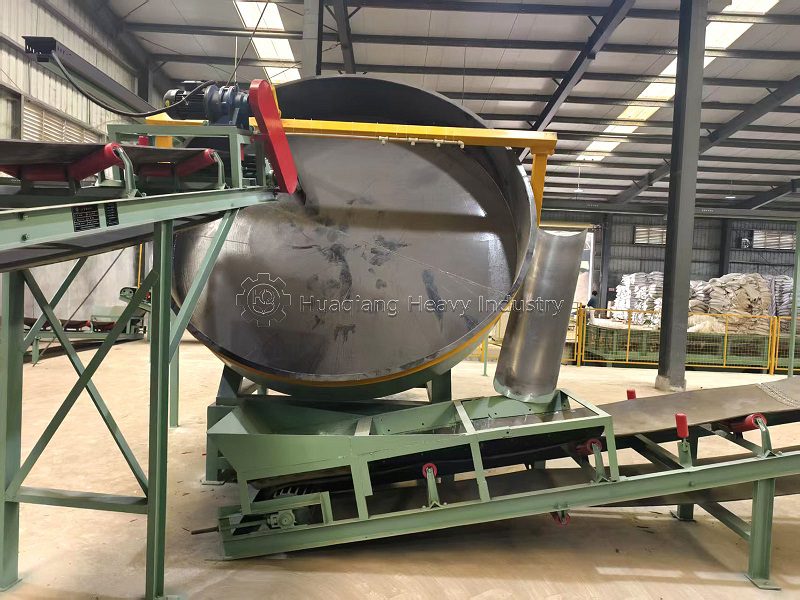
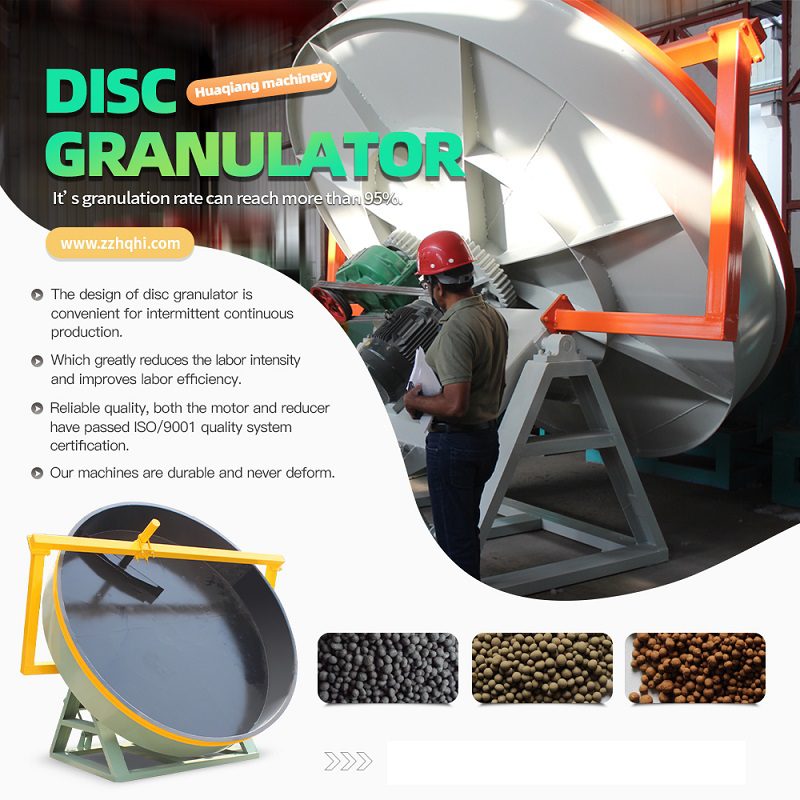
The mixed material enters the granulation system. There are two main processes: Disc granulators use the synergistic effect of the disc’s tilt angle (45°–55°) and rotation speed to cause powder to adhere layer by layer into granules, with a controllable particle size of 2.5–4.5 mm and a yield of approximately 70%–80%; extrusion granulators use forced extrusion with rollers, forming cylindrical granules without the need for binders, resulting in higher strength and suitability for high-hardness materials. After granulation, the moisture content of the granules remains at 25%–30%, requiring immediate transport to the drying section.
Fifth Stage: Rotary Kiln Drying and Hot Air Balancing The granular material enters the rotary dryer, with the cylinder tilted at 2°–4° and rotating at 6–8 r/min. A hot air furnace provides a hot airflow of 300℃–400℃, contacting the material in co-current or counter-current flow, rapidly reducing the particle moisture content from approximately 30% to 12%–15%. Precise temperature control is crucial: the discharge temperature should not exceed 80℃, otherwise organic matter will easily char and be lost. The inlet hot air temperature and material residence time (usually 15-20 minutes) jointly determine the dehydration efficiency. A cyclone dust collector and spray tower are installed at the dryer outlet to ensure that exhaust gas meets emission standards.
Sixth Stage: Forced Cooling and Granulation The dried granules reach temperatures as high as 60℃-70℃; direct packaging will lead to condensation and mold growth inside the bags. A counter-current cooler is needed to force cooling using natural or cold air to bring the granule temperature down to within 5℃ of ambient temperature. After cooling, the material enters a secondary vibrating screen to separate oversized particles (returned for crushing) and fine powder (returned for granulation). Qualified granules (2.0-4.5 mm) proceed to the next process. The sieving efficiency should be ≥95% to ensure a uniform appearance of the finished product.
Seventh Stage: Automatic Weighing and Sealing The final qualified granules are automatically weighed by a computer-controlled combination scale according to the set net weight (usually 25 kg, 40 kg, or 50 kg), with an error controlled within ±0.2%. The packaging uses double-layered woven bags with an inner moisture-proof film, sealed by heat sealing or a sewing machine, and simultaneously printed with the production batch, nutrient label, and production date. A palletizing robot stacks the finished products onto pallets, which are then wrapped by a stretch wrapping machine before being stored in the warehouse. This completes the transformation of livestock manure into commercial organic fertilizer.
The entire process requires careful attention to dust explosion prevention and odor collection and treatment. The material flow rate of each process should match the production capacity (a redundancy factor of 1.2 is recommended). This production line not only solves the pollution problem caused by livestock farming but also transforms waste into marketable agricultural inputs, achieving a balance between environmental benefits and economic value.
The seven‑step process transforms raw livestock manure into a standardized, marketable organic fertilizer through the seamless integration of biological, mechanical, and thermal technologies. It begins with a windrow composting machine or trough system for high‑temperature aerobic fermentation, where an animal manure compost turner ensures uniform aeration and temperature control. For dedicated poultry operations, a chicken manure fertilizer machine can be integrated upstream to handle high‑moisture material, while an animal manure processing machine prepares the feedstock for the subsequent crushing and mixing stages. The core granulation step relies on a granulator machine for organic fertilizer – whether a disc granulator machine for spherical pellets or an extrusion granulator for high‑strength cylinders – to produce uniform particles. After granulation, a fertilizer drying and cooling machine reduces moisture to the required level (12‑15%) and lowers the temperature to near ambient, ensuring product stability and preventing caking. Finally, automatic screening and packaging deliver a consistent, high‑quality product. This integrated equipment train not only solves the environmental challenge of manure disposal but also creates a valuable revenue stream, turning a liability into a profitable, sustainable agricultural input – a true win‑win for farms, the environment, and the fertilizer industry.