
There is a pressing need for large-scale manure composting,large wheel compost turners enable deep fermentation and harmless treatment
Natural anaerobic composting requires 60 days to mature in summer and up to 90 days or more in winter. As the scale of livestock farming continues to expand, many farms employ improper composting methods—such as random open-air piling and rudimentary manual turning—which present significant drawbacks. First, it pollutes the environment: unfermented manure emits foul gases like ammonia and hydrogen sulfide and breeds pests and pathogens; rainwater runoff carries manure-laden wastewater into the soil and waterways, causing eutrophication. Second, it harms agricultural production: internal parasite eggs, pathogens, and antibiotic residues remain active, so direct application to fields can easily cause crop “burning” (fertilizer burn), soil compaction, and the cross-transmission of pests and diseases. Third, composting efficiency is extremely low: manual turning results in uneven oxygen supply, fermentation cycles last two to three months, and the degree of maturity varies; the resulting manure is of poor quality—failing to meet sales standards—and occupies vast amounts of space, making it unsuitable for the demands of large-scale manure treatment.
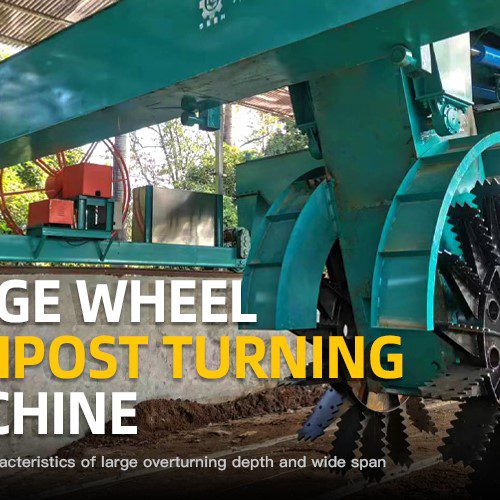
To address the pain points of large-scale manure composting, the large wheeled compost turner—commonly known in the industry as the “large-wheel turner“—serves as core equipment for standardized manure treatment. Designed specifically for trough-style aerobic fermentation, it utilizes a massive rotating wheel to break up, oxygenate, cool, and mix the manure, facilitating rapid, harmless decomposition. The equipment boasts distinct advantages: it features a wide turning span and deep working depth, capable of processing massive quantities of manure in a single pass and perfectly suiting 10,000-ton-scale organic fertilizer production lines. Its wheel offers powerful crushing capabilities, breaking up clumpy, high-moisture manure and ensuring uniform mixing with straw-based bulking agents. Equipped with a fully automatic PLC control system, it can perform autonomous, scheduled turning, reducing labor costs by 70%. Fermentation temperatures are precisely controlled, maintaining a stable 60–70°C environment to thoroughly eliminate parasite eggs and pathogens, ensuring compliance with harmless treatment standards. The machine features thickened, wear-resistant impellers and a low failure rate, supporting continuous, all-weather operation ideal for long-term production at large-scale facilities. The operational requirements are clear and specific: the system requires reinforced concrete fermentation channels and is designed for use within enclosed facilities. It accommodates various types of livestock and poultry manure—such as cattle, pig, and chicken manure—with an optimal feedstock moisture content of 55%–65%. Suitable for large-scale operations at livestock farms and organic fertilizer processing plants, the system can be put into production provided there is a well-organized site and a stable 380V industrial power supply.
These components complement each other, effectively overcoming the shortcomings of inefficient composting methods. The large wheel compost turning machine addresses the flaws inherent in simple manual composting—namely insufficient aeration, uneven fermentation, and incomplete pathogen elimination. By maintaining a standardized channel-based fermentation cycle of 25–30 days, it eliminates foul odors and risks of soil and water pollution at the source, yielding high-quality organic fertilizer. It offers a compliant solution to the challenges of large-scale manure treatment while simultaneously transforming waste into a value-added resource, making it essential equipment for green, compliant composting in the livestock industry.