
Secrets to Enhancing Mixing Uniformity in Double Axis Paddle Mixers
Improving mixing uniformity in double axis mixers has long been reduced to a game of adjusting isolated parameters such as rotational speed, mixing time, and fill ratio. However, the true determinant of material dispersion lies in the profound manipulation and active reconfiguration of the flow field structure within the mixing chamber. To achieve a quantum leap in uniformity, one must break free from the inertia of simply stacking parameters and instead adopt an innovative design philosophy rooted in flow field mechanics and particle kinematics.
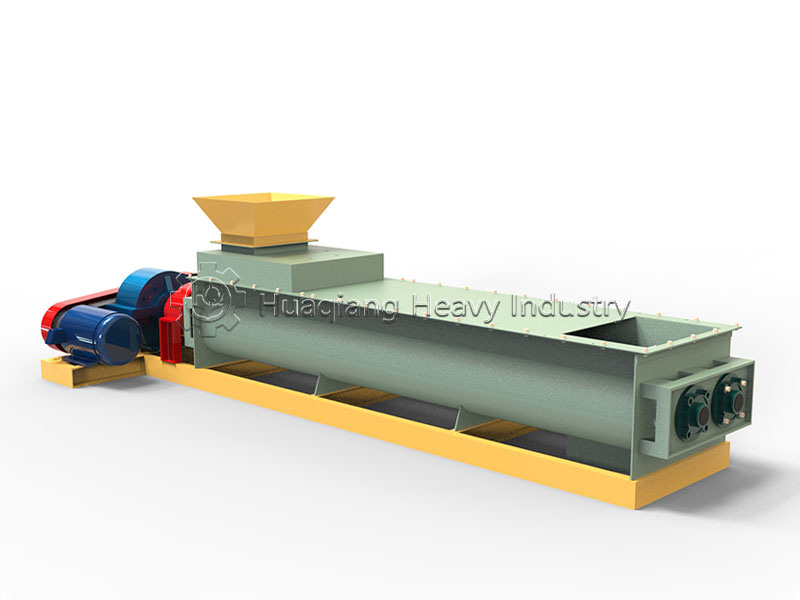
Topological optimization of the paddle structure serves as the primary breakthrough for overcoming uniformity limitations. The key lies in applying “surgical-precision” interventions to the spatial layout of the paddles, rather than merely increasing the number of mixing cycles. Research indicates that installing smaller paddles on the support arms between conventional large paddles—creating a dual-layer structure of large and small paddles—generates unexpected “spatial intervention” effects. Furthermore, employing asymmetrical paddle arrangements or variable-cross-section helical structures allows for a gradual change in paddle pitch from root to tip (e.g., from 15° to 30°); this increases the material’s radial velocity by approximately 22% and slashes the standard deviation of axial mixing uniformity to below 0.08. This design ingeniously transforms a simple “pushing” action into multi-dimensional “kneading” and “stretching,” fundamentally altering the forces acting on the material and its trajectory.
The secret to enhancing mixing uniformity in double axis mixers lies in a cognitive shift from “experience-driven” to “flow-field-design-driven” approaches—transforming the mixing process from blind, high-intensity agitation into the precise orchestration of material movement dynamics. Whether reconfiguring flow field energy distribution through dual-layer paddle structures or utilizing rotational speed and phase differences to create beneficial flow field interference, all these innovations point to a single core principle: uniformity is not merely agitated into existence; it is engineered. Only by broadening our perspective from individual equipment components to the coupled system of flow field, particles, and process can the performance potential of double axis mixers be fully unleashed, thereby establishing formidable technical barriers in the fiercely competitive sectors of animal feed, food processing, and chemical manufacturing.