
【FAQ】Fertilizer Machinery and Equipment Technology – Rotary Drum Granulator or Disc Granulator for 100,000 Tons/Year Chicken Manure Organic Fertilizer Production?
Should a rotary drum granulator or a disc granulator be chosen for a 100,000-ton/year chicken manure organic fertilizer production line?
Rotary drum granulators (1-2 large-scale units) are the preferred choice. Disc granulators are not recommended as the main equipment for a 100,000-ton/year production line. The granulation process for a 100,000-ton/year chicken manure organic fertilizer production line (based on 300 working days per year, 20 hours of production per day, with an hourly output of approximately 16-17 tons) places stringent requirements on the equipment’s single-machine capacity, continuous operation capability, and operational stability—and these three aspects are precisely the weaknesses of disc granulators.
First, calculate the capacity: How fast does a 100,000-ton/year production line need to be?
A 100,000-ton/year production line translates to an hourly output requirement for the granulator: approximately 333 tons per day. Based on 20 hours of production per day, the hourly output requirement is approximately 16.7 tons/hour. This leads to the following configuration options for the two types of machines:
Disc Granulator: A single machine produces approximately 1-5 tons per hour. To achieve a capacity of 16 tons per hour, 4-6 units need to operate in parallel.
Drum Granulator: A single machine can produce 8-15 tons per hour (larger models can reach 20-30 tons per hour). 1-2 units are sufficient.
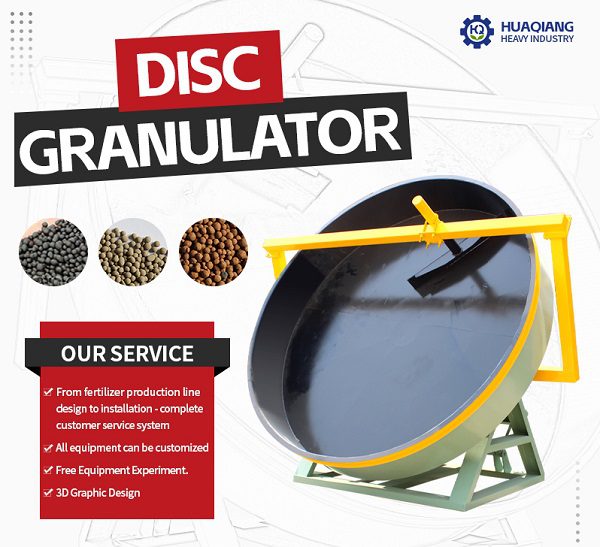
Three Reasons Why Disc Granulators Are Unsuitable for 100,000-Ton Capacity Lines:
Multiple Machines in Parallel Operation: Complex management and inflated capacity: Operating 4-6 disc granulators simultaneously requires multiple sets of feeding, discharging, and control systems, resulting in a large footprint and high management costs. More importantly, disc granulation relies on manual monitoring and control of the pelletizing process. With multiple machines running simultaneously, manual supervision is difficult, often leading to actual capacity falling short of the nominal value. Industry data shows that many 100,000-ton chicken manure production lines “assembled” with 4-6 disc granulators only produce 60,000-70,000 tons annually.
Pelletizing is dependent on manual labor, resulting in unstable quality: The pelletizing quality of disc granulators is greatly affected by the operator’s experience. Inclination angle, rotation speed, and water spray volume require frequent adjustments. When multiple machines are connected in parallel, it is difficult to unify the particle size of the output from each disc, leading to poor uniformity of the finished pellets.
Mismatch with chicken manure raw material characteristics: The moisture content of well-rotted chicken manure is generally 30%-50%. Disc granulators are sensitive to moisture, typically requiring a moisture content control of 15%-25%. Fluctuations in raw material properties significantly reduce the pelletizing rate.
Core Advantages of Rotary Drum Granulators: Rotary drum granulators can operate continuously for 24 hours without interruption, with a high degree of automation and a uniform and stable output speed. The pellets are tightly bound, high in strength, and round and uniform, achieving a pelletizing rate of 85%-90%. Although the equipment investment is relatively high (approximately 150,000-250,000 RMB per unit), 1-2 units are sufficient to meet the production capacity, resulting in a lower overall investment and operating cost per ton of equipment.
Selection Conclusion: For a production line with an annual output of 100,000 tons of chicken manure organic fertilizer, a rotary drum granulator is the only reasonable choice. While disc granulators have a lower investment threshold, the management difficulties, capacity losses, and quality fluctuations resulting from operating multiple machines in parallel ultimately lead to a significantly higher overall cost compared to rotary drum granulators. Before selecting a model, it is recommended to request a written commitment from the equipment manufacturer that it is “designed for 16 tons/hour” to avoid discrepancies between advertised data and actual capacity.