
Application Scenarios and Core Advantages of Large Wheel Compost Turners
In the fields of large-scale organic fertilizer production and organic waste resource utilization, large wheel compost turners (also known as wheel-type compost turners) are becoming the preferred equipment for large-scale fermentation projects. They stand out among many compost turner models due to their unique structural design and superior operational capabilities. This article will provide a comprehensive analysis of this “fermentation plant behemoth” from two dimensions: applicable scenarios and core advantages.
What Scenarios are Large Wheel Compost Turners Suitable For?
Large wheel compost turners are specifically designed for large-span, high-depth organic waste fermentation and turning. Their applicable scenarios are extremely wide, mainly including: Large-scale organic fertilizer production is its primary application area. For large organic fertilizer plants with an annual output of over 10,000 tons, traditional turning equipment often struggles to meet the fermentation demands of large pile heights and large material volumes. However, a single large disc compost turner can easily handle over 200 tons per day, making it an ideal choice for continuous production in 10,000-ton-level organic fertilizer plants.
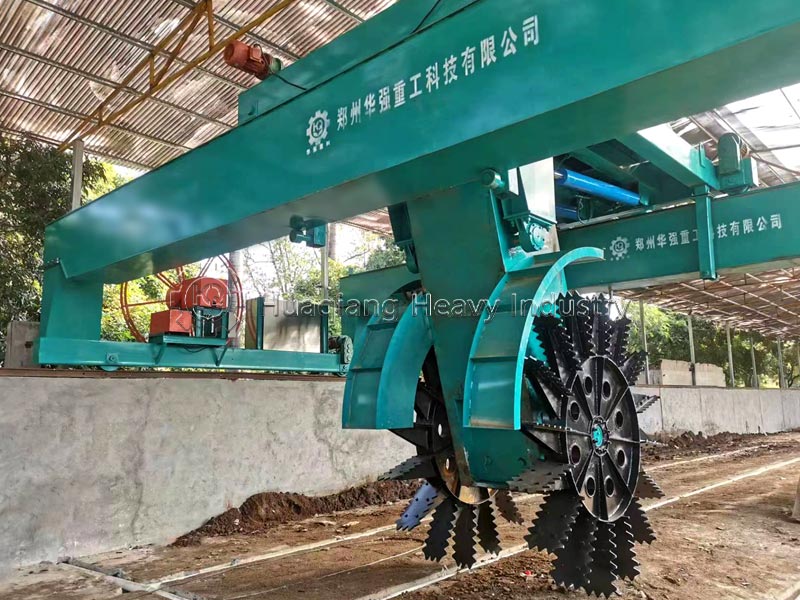
Large-scale livestock farm manure treatment also relies heavily on it. Livestock manure, such as that from pigs, cattle, sheep, and chickens, is produced in large quantities, has a high moisture content, and is prone to compaction. The powerful turning and turning capacity of the large disc compost turner can quickly break up the compacted layer, and through high-temperature fermentation, kill pathogens and weed seeds, achieving the harmlessness and resource utilization of manure.
Municipal sludge treatment is another important application area. Large quantities of sludge produced by urban wastewater treatment plants, after passing testing, can be treated with aerobic fermentation using the large wheel compost turner. The turning process can reduce the sludge moisture content from approximately 80% to below 60%, stabilizing and deodorizing it before converting it into safe organic fertilizer.
In addition, industrial organic waste such as sugar mill filter mud, winery residue, and traditional Chinese medicine residue, as well as agricultural crop straw and garden waste, can all be utilized on a large scale using the large wheel compost turner. This equipment is also commonly used for substrate fermentation and composting in horticultural farms and mushroom cultivation plants.
What are the core advantages of the large disc compost turner?
The advantages of the large-wheel compost turner are concentrated in the following five aspects:
High turning depth and wide span: Its turning depth can reach 1.5 to 3 meters, far exceeding the 1 to 1.2 meters of ordinary compost turners. The maximum turning width can reach 30 meters. This means that taller material piles can be built, increasing the material volume by more than 30% in the same area.
Low energy consumption: Adopting a high-efficiency energy-saving transmission mechanism, it reduces energy consumption by 70% compared to traditional compost turners for the same workload. Low operating energy consumption effectively reduces production costs.
No dead angles in turning: Symmetrical disc turning, combined with a speed-adjustable shifting trolley, achieves no dead angles in operation. The three-dimensional turning method (shoveling, throwing, tossing, and shifting) ensures thorough mixing of materials, effectively breaking up lumps, improving material porosity, and ensuring uniform oxygen distribution.
High degree of automation: Equipped with a fully automated electrical control system, it can achieve automatic walking, automatic lifting, and automatic turning, requiring no manual operation during operation.
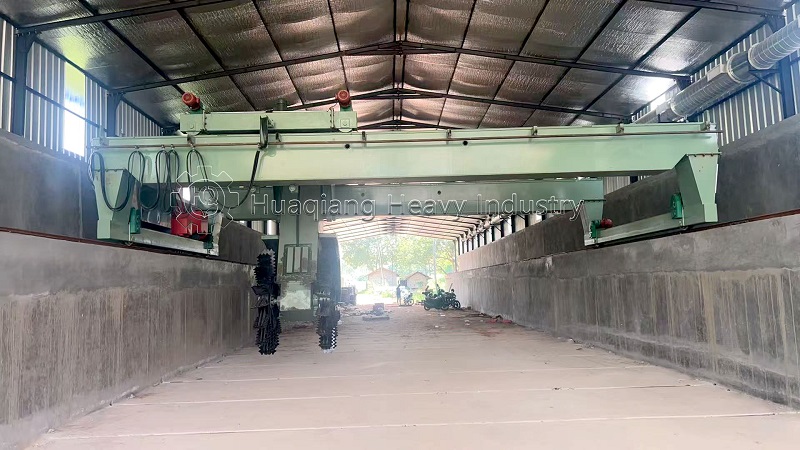
High turning efficiency and high quality: Large-wheel compost turners have a processing capacity of 200 to 500 cubic meters per hour. Through uniform turning and ample oxygen supply, the compost pile temperature can quickly rise to 60 to 70°C, effectively killing pathogens. The fermentation cycle is shortened from several months to several weeks. The material decomposition is uniform and consistent, effectively improving the quality of the finished organic fertilizer.
In conclusion, with its outstanding features of “large span, deep turning, low energy consumption, and high automation,” the large-wheel compost turner has become a core piece of equipment for fermentation and turning in large-scale organic fertilizer plants, large-scale livestock farms, and municipal sludge treatment centers. In today’s rapidly developing organic fertilizer industry towards large-scale and standardized production, understanding the applicable scenarios and core advantages of large-wheel compost turners is an important prerequisite for investors and equipment selectors to make informed decisions.