
How to Configure the Granulation Section of a 100,000-ton Organic Fertilizer Production Line?
For a 100,000-ton-per-year granulation line, based on 300 days and 20 hours per day, the nominal hourly output of the granulation section needs to reach 16-17 tons. Considering raw material fluctuations and equipment maintenance, the industry consensus is to reserve 15%-20% capacity redundancy, so the actual hourly output should fall within the range of 20-25 tons. The first watershed in the granulation section is not the main equipment model, but the moisture content of the fermented feed: conventional fermented feed with 30%-40% moisture content requires drying with the agitator gear/disc wet process; if the moisture content can be reduced to 15%-25% and the goal is to avoid drying investment, the roller extrusion dry process is a more economical route. Both routes are viable at the 100,000-ton scale, but the prerequisites are completely different.
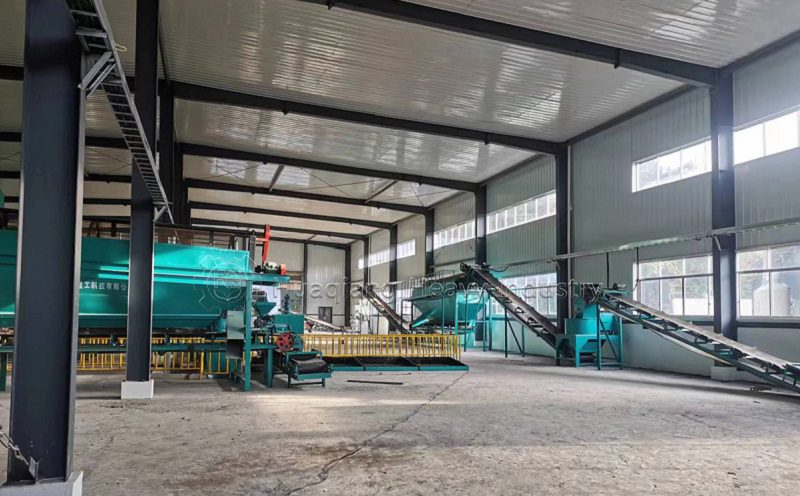
I. Budget Breakdown for Granulation Section: Drying is the Biggest Variable Besides the Main Unit
The granulation section of a 100,000-ton production line is not simply about “buying a single granulator,” but rather a combination of equipment. Taking the wet-process stirring toothed granulator route as an example, the core configuration includes: a stirring toothed granulator (6-15 tons per hour, single unit power 45-90 kW), a dryer, a cooler, a screening machine, a return material conveying system, and supporting dust removal and electrical control systems. If a dry-process double-roller granulator route is adopted, the main unit is replaced with a double-roller extrusion granulator (2-12 tons per hour, single unit power 30-75 kW), but the dryer and cooler can be omitted, significantly shortening the equipment list.
The core difference in budget lies not in the granulator itself, but in whether “drying is included in the process.” The investment in the granulation section of the wet process involves adding a drying system (hot air furnace, drying drum, induced draft fan, dust removal), which is typically several times the price of the granulator itself for a 100,000-ton production line. The dry process eliminates this system, which incurs continuous fuel costs, rather than simply offering a cheaper granulator. Comparing only granulator prices during selection will severely underestimate the true investment difference between the two processes.
II. Fermentation Moisture – Granulation Route: Selection Cannot Be Determined Independently Based on Upstream Moisture Content
The selection of the granulation section for a 100,000-ton production line must be based on the moisture content of the fermentation output. The two main matching logics are: Stirring Tooth/Disc Wet Process: Feed moisture 30%-40%, with accompanying drying. Stirring tooth granulators are suitable for high-moisture, high-fiber materials (such as livestock and poultry manure, distiller’s grains, mushroom residue), with a suitable moisture content of 50%-60% and a granulation rate ≥85%. The feed moisture content for disc granulation is typically 30%-40%. Pelletization is sensitive to moisture content; below 30%, pelletization is difficult, and above 40%, pellets stick to the disc. A common cost of wet granulation methods is the necessity of drying: the granulated particles still have a moisture content of 20%-35%, making safe storage impossible without drying.
Dry granulation using roller extrusion: Feed moisture content is 2%-10% (this can be relaxed to 15%-20% for pure organic fertilizer), generally requiring no drying. Roller extrusion relies on mechanical pressure for forming, not a water film, therefore lower feed moisture content results in smoother processing. A prerequisite is that the fermented product must undergo aging, remixing, or dehydration to force the moisture into the extrusion window. If the fermented product moisture content remains above 35% for an extended period, the roller extrusion method is eliminated at the first hurdle; forcing it will result in slippage, roller sticking, and a sharp drop in output.
Decision-making sequence: First, determine the stable moisture range of the fermented product, then select the appropriate method. For raw materials with a stable moisture content of ≤25% and where investment in aging/dehydration facilities is possible, the roller drying method saves on drying costs. For raw materials with a consistently high moisture content of 30%-40% and high viscosity, the agitator/disc wet method combined with drying is a more reliable match.
III. Capacity Redundancy: Why a 100,000-ton production line cannot be selected based on a “full capacity” of 16.7 tons/hour
Based on an annual output of 100,000 tons, 300 effective production days, and 20 hours per day, the theoretical hourly output is 16.7 tons/hour. However, this figure cannot be directly used as the basis for selecting a granulator.
The industry practice is to reserve 15%-20% capacity redundancy, ensuring that the hourly output of the granulation section falls within the range of 20-25 tons/hour. Redundancy is not about “wasting capacity,” but rather about covering three inevitable fluctuations: raw material moisture fluctuations (fermentation output moisture is not constant; high moisture content reduces granulation speed), equipment maintenance downtime (a 100,000-ton line cannot operate at full capacity without failure for 300 days a year), and peak order volumes (peak seasons require short-term overproduction). A line without redundancy will experience repeated stalls in its first year of operation when moisture content is high or orders are concentrated, and the cost of subsequent expansion far exceeds the 15% extra capacity allocated during selection.

IV. FAQ: High-Frequency Issues Regarding Granulation Section Configuration for a 100,000-ton Line
Q1: How many people operate a 100,000-ton line? Does the granulation section require dedicated monitoring?
The granulation section typically requires 1-2 people per shift. With a high degree of automation, 6-10 people can cover the entire plant. The granulation unit itself does not require continuous manual intervention, but the return material status, die/agitator wear, and moisture level require regular inspection. The key operational aspects of a dry roller extrusion line are roller surface cleaning and gap inspection; for a wet agitator/drum line, the focus is on spray/steam regulation and drying temperature monitoring. If the entire line is equipped with centralized PLC control, manpower can be further shifted towards inspection and quality control, rather than staying by each individual machine.
Q2: Roller extrusion only has an hourly output of 8-10 tons; does a 100,000-ton line require many units?
The maximum hourly output of a single roller extrusion unit is approximately 12 tons. A 100,000-ton line typically requires 2-3 units in parallel for the granulation section. This is a structural characteristic of dry processes at the 100,000-ton level: the single-unit capacity ceiling is lower than that of wet agitator/drum lines, but the total hourly output after parallel operation can cover the selection target of 20-25 tons. The cost of multiple units in parallel is land occupation and replication of auxiliary systems, but the advantage is the elimination of the drying system and its fuel costs. When selecting a granulator, the total investment and operating cost of “multiple roller mills + no drying” should be compared with that of “single wet mill + drying,” rather than just comparing the unit price of the granulator.
Q3: If the fermentation moisture content is 35%, and I want to use roller mills to save on drying, do I need to buy a dryer to reduce the moisture content first?
It’s not necessarily “drying,” but “reducing moisture” is essential. The feed window for roller extrusion is 15%-25% (this can be relaxed for pure organic fertilizer). 35% moisture content will cause slippage and sticking to the rollers if fed directly. Possible ways to reduce moisture include extending the aging and turning process, remixing and drying, and mechanical dehydration; drying is just one option. If space and time permit, remixing + aging can gradually reduce moisture without adding heat source equipment, at the cost of a longer fermentation/aging cycle and increased floor space. If these conditions are not met, wet milling + drying is a more realistic continuous production solution.