
A Systematic Approach to Organic Fertilizer Production: From Raw Materials to Finished Products
Converting livestock manure, straw, sludge, and other organic waste into high-quality organic fertilizer requires a complete equipment system. From raw material pretreatment to finished product packaging, each process has corresponding specialized equipment, and the matching degree of equipment directly determines production efficiency, product quality, and operating costs. This article outlines a complete equipment list for organic fertilizer production and provides matching solutions based on production capacity requirements.
Pretreatment Process: Creating Conditions for Fermentation
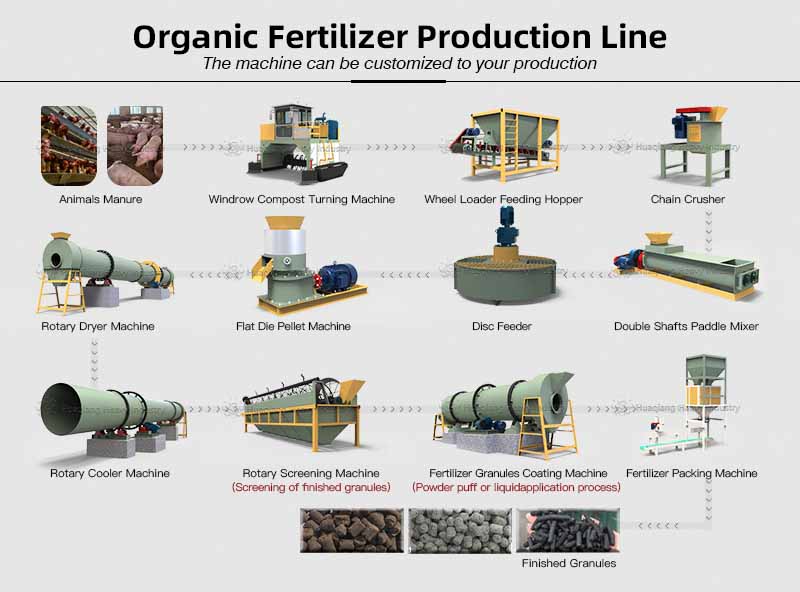
Raw material pretreatment is the foundation for successful fermentation. A screw extruder reduces the moisture content of fresh manure from over 80% to around 60%, reducing the burden on subsequent fermentation. A high-moisture material crusher pulverizes manure and straw to below 5mm, increasing the specific surface area of the material. A horizontal twin-shaft mixer mixes different raw materials at a carbon-to-nitrogen ratio of 25-30:1 and evenly adds fermentation agents.
Fermentation Process: The Core of Aerobic Composting
A trough-type or chain-plate type compost turner is the core equipment for aerobic fermentation. The equipment moves back and forth along the fermentation trough or windrow, periodically turning the material to achieve forced ventilation and oxygen supply. The fermentation cycle is 15-25 days. After fermentation, the material is odorless and has a fresh earthy aroma. Large-scale bases can be equipped with automatic shifting and turning machines, allowing one person to manage multiple fermentation tanks.
Granulation Process: From Powder to Granules
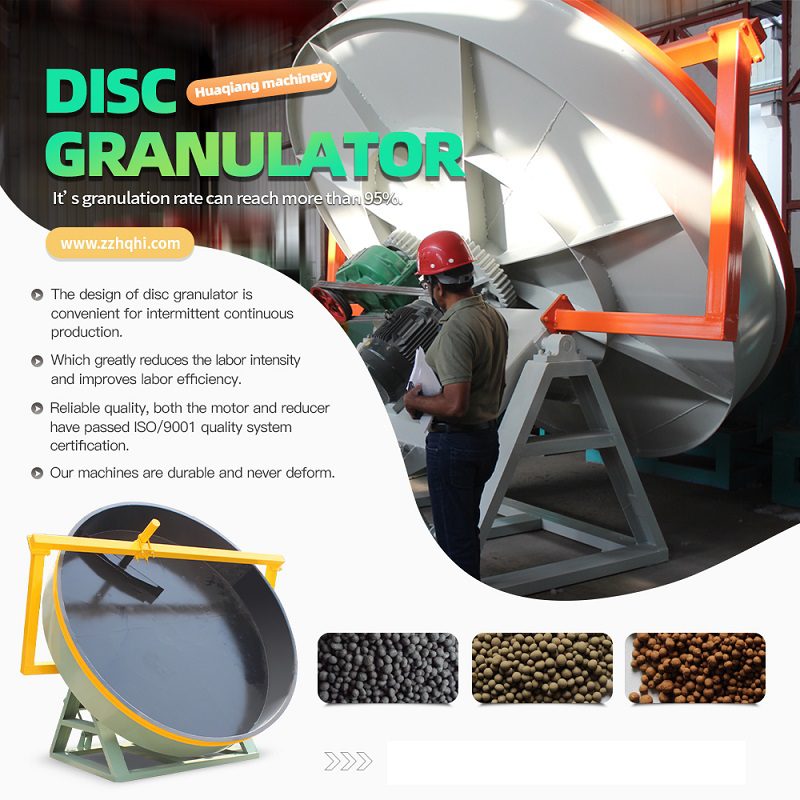
The fermented powdered organic fertilizer needs to be granulated to become a marketable product. Disc granulators use rotating inclined discs to agglomerate the material into spherical pellets, resulting in uniform pellets. The operation is intuitive and suitable for small to medium-scale production. Roller extrusion granulators use a dry forming process, eliminating the need for drying and producing high-strength pellets, suitable for production lines with an annual output of over 20,000 tons. Flat die granulators are specifically designed for pure organic fertilizer and can produce cylindrical pellets.
Drying and Cooling Process: Key to Preserving Activity
Organic fertilizer pellets need to be dried at low temperatures (≤60℃) to reduce the moisture content from 25%-30% to below 15%, while simultaneously protecting the activity of beneficial microorganisms. Rotary dryers use a high-volume, low-temperature process, and the discharged material immediately enters a cooler to cool to ambient temperature, preventing moisture absorption and clumping.
Screening and Packaging Process: Finished Product Standardization
The drum screen separates qualified granules (2-5mm) from fine powder and oversized particles; unqualified products are returned to the granulation process. The automatic quantitative packaging machine completes packaging at a speed of 6-10 bags/minute, with a weighing error ≤ ±0.2%.
Production Capacity Matching Plans:
2-5 tons/hour (6,000-15,000 tons/year): High-moisture crusher + chain plate turning machine + disc granulator + drum screen + semi-automatic packaging machine; investment US$80,000-150,000; land area 500-800 square meters.
5-8 tons/hour (15,000-25,000 tons/year): Extrusion dewatering machine + trough turning machine + double-roller extrusion granulator + rotary dryer and cooler + automatic packaging machine; investment US$200,000-350,000; land area 1000-1500 square meters. 8-12 tons/hour (25,000-40,000 tons/year): Features a fully automated pretreatment line + multi-tank parallel turning and pounding + large-scale roller granulation + high-efficiency drying and cooling + robotic palletizing. Investment: US$450,000-700,000, occupying 2,000-3,000 square meters.
Energy-saving, environmentally friendly, and odorless design: The entire line incorporates multiple environmental protection designs: waste gas from the fermentation zone is deodorized by a biological filter before discharge; dust from granulation and drying is recovered by a pulse bag filter; and production wastewater is settled and reused for raw material conditioning. In terms of energy saving, the dryer uses a waste heat recovery system, and the hot air discharged from the cooler can be used for workshop heating. The overall energy consumption per ton of product is reduced by 25% compared to traditional processes.
The complete equipment list for organic fertilizer production forms an integrated organic fertilizer manufacturing system. The journey begins with organic fertilizer raw material processing equipment, such as a half-wet material crusher machine, which prepares the fermented compost to the ideal particle size. This prepared material is then ready for the granulation stage, the essence of organic fertilizer production granulation equipment. Within the organic fertilizer granulator series, several options exist. For producing high-quality, spherical granules, a complete organic fertilizer disc granulation production line is a classic and effective choice. For operations seeking a compact, efficient solution, a new type two in one organic fertilizer granulator can combine the final stages of conditioning and initial granulation. For very small-scale or specialty applications requiring cylindrical pellets, a flat die press pellet machine for sale provides a low-cost entry point. The selection of the right organic fertilizer production equipment depends on the production scale, raw material characteristics, and desired final product form. For a small 2-5 t/h line, a disc granulator is ideal; for a larger 5-8 t/h line, a roller extrusion granulator is more suitable. The integrated system, from the initial crusher to the final packer, transforms raw waste into a consistent, high-value granular product. The matching of equipment capacity—from pretreatment to fermentation to granulation—is the key to a successful and efficient organic fertilizer manufacturing system.
From chicken manure to granular fertilizer, from cow manure to organic resources, a scientifically matched equipment system can truly transform waste into valuable green resources. We welcome you to provide your raw material list and production capacity requirements to obtain a customized equipment solution.