
Beyond Price, Consider “Stickiness”: The Underlying Logic and Six-Dimensional Comparison of Organic Fertilizer Granulator Selection
Organic fertilizer granulators come in a wide variety, with significant differences in operating principles, capacity, and raw material compatibility. Choosing the right equipment can drastically improve production efficiency and product quality; choosing the wrong model can lead to frequent blockages, loose granules, and high costs. This article systematically compares the technical features and applicable scenarios of six types of granulators: disc granulators, drum granulators, double roller granulators, new-type stirring teeth granulators, flat die granulators, and hydraulic roller granulators.
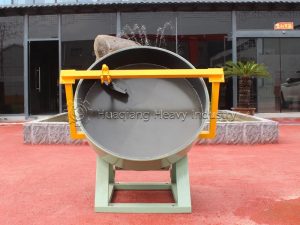
Disc Granulator: A Flexible Choice for Small to Medium Scale Production
Disc granulators use a rotating, tilted disc to agglomerate materials into granules, achieving a granulation rate of 80%-85%. Its advantages include simple structure, low investment (US$30,000-80,000), and intuitive operation, making it particularly suitable for organic fertilizer plants with an annual production capacity of less than 10,000 tons and frequent formula changes. The disc tilt angle is adjustable from 35° to 55°, producing 1-5mm granules. The drawbacks are relatively small single-machine capacity (0.5-3 tons/hour) and sensitivity to material moisture content, which needs to be controlled within 20%-25%.
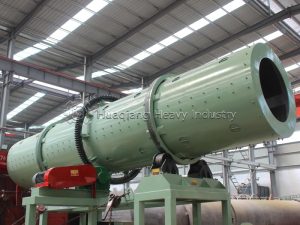
Drum Granulator: The Mainstay of Large-Scale Continuous Production
Drum granulators use a steam-assisted agglomeration process, with a single-machine hourly output of 8-15 tons, a granulation rate of 85%-90%, and high granule roundness. The equipment is equipped with rubber or stainless steel liners and an automatic descaling device, suitable for processing sticky organic materials. Investment is higher (US$150,000-400,000), requiring a boiler and drying system; the comprehensive energy consumption per ton of product is approximately 25-30 kWh. Suitable for large-scale organic fertilizer bases with an annual output of over 50,000 tons.
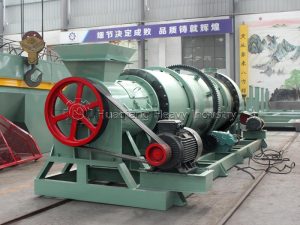
New Type of Stirring Tooth Granulator: Specialized equipment for high-moisture organic materials. The stirring tooth granulator uses a high-speed rotating stirring tooth rotor to forcibly crush and agglomerate wet materials with a moisture content of 20%-30% into cylindrical granules. It is highly adaptable to sticky and fibrous materials, does not clog, and has a single-machine output of 3-8 tons per hour. Investment of $50,000-$120,000 is ideal for processing fresh manure, biogas residue, and kitchen waste.
Flat Die Granulator: Cylindrical granule solution for pure organic fertilizer. The flat die granulator uses a rotating flat die and pressure rollers to extrude material from the die holes into cylindrical granules with an adjustable diameter of 1.5-8mm. Its advantages are high granule density and uniform appearance, making it particularly suitable for the production of pure organic fertilizer (organic matter ≥60%). Single-machine output is 1-4 tons per hour, with an investment of $30,000-$80,000. The drawback is that the die orifice is prone to clogging, requiring strict control of raw material fineness and moisture content.
Selection Based on Raw Materials and Capacity
For processing high-moisture, sticky materials (fresh manure, biogas residue), agitator granulators or disc granulators are preferred. For processing high-fiber, dry materials (straw, mushroom residue), roller extrusion or flat die granulation is more suitable. For high-capacity, continuous production, drum granulation is the mainstream solution. For small and medium-sized factories with limited budgets, disc or flat die granulation can provide a quick start. For high-end products with stringent requirements for pellet strength, the hydraulic roller granulator is the best choice.
From the flexibility and economy of disc granulators to the economies of scale of rotary drum granulators, from the energy efficiency of double roller granulators to the precise pressure control of hydraulic roller granulators, the organic fertilizer granulator series covers all scenarios from 1 ton to 20 tons, from wet materials to dry materials, and from organic to compound materials. Choosing the right model will ensure your organic fertilizer production line achieves both quality and efficiency.
The choice of granulator is the centerpiece of any organic fertilizer production equipment line. The decision process must begin with the organic fertilizer fermentation process, as the characteristics of the fermented material (moisture, fiber content) dictate the optimal granulation path. This material is then prepared using essential organic fertilizer raw material processing equipment, such as a half-wet material crusher machine. Within the organic fertilizer granulator series, a wide array of technologies exists. For producing high-quality, spherical granules, a complete organic fertilizer disc granulation production line is a classic and effective choice. For operations seeking a compact, efficient solution, a new type two in one organic fertilizer granulator can combine the final stages of conditioning and initial granulation. The selection guide—comparing disc, drum, roller, and flat die machines—provides a framework for matching the granulator’s capabilities to the specific production scale, raw material properties, and desired final product characteristics. Understanding the unique strengths of each technology in the organic fertilizer granulator series is essential for building a production line that transforms organic waste into a consistent, high-value granular product efficiently and cost-effectively.