
Chain Compost Turner: The Oxygen Pump of Fermentation?
Ever wondered how mountains of chicken manure, straw, and biogas residue transform into earthy-smelling compost in just weeks? The secret lies in the chain compost turner and its tirelessly moving “chain claws.” It’s the undisputed star of aerobic fermentation, responsible for injecting life-giving oxygen into slumbering compost piles.
The story begins in newly built fermentation troughs. Organic wastes—livestock manure, crop straw, distiller’s grains—are mixed and filled into troughs up to 2-24 meters wide and 2-3.5 meters deep. Enter the chain plate turner, moving along rails on the trough walls. Its core component is a motor-driven chain plate fitted with hundreds of wear-resistant curved teeth—some models boast up to 390 blades. As the chain runs, these teeth dig into the pile’s bottom, lifting material 1.5-2.8 meters thick, carrying it upward, and then hurling it through the air. This single “dig-and-toss” action instantly exchanges internal heat, moisture, and stale air with fresh oxygen—a giant “oxygen pump” in action.
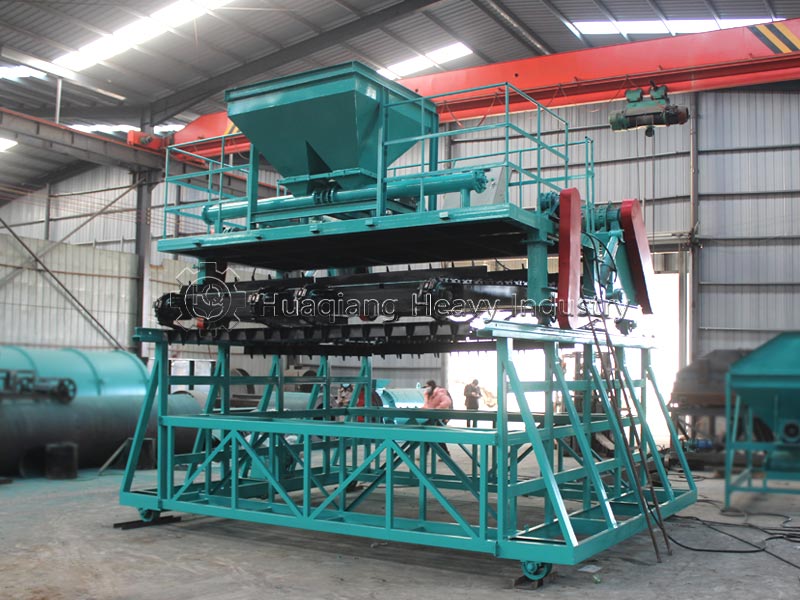
But the chain turner’s ingenuity goes deeper. Its inclined chain plate typically forms two angled surfaces—a steeper first section (40-55°) for effective digging, and a gentler second section (10-30°) that retains material longer, achieving “high-altitude scattering”. As material falls, it contacts air thoroughly, rapidly cooling and drying while oxygen penetrates deep to activate aerobic microbes. Advanced models even incorporate a crushing mechanism at the junction of the two angles, using rubber-toothed rollers to break clumps, ensuring the turned pile remains fluffy and uniform.
Even more impressive is its “respiratory system”—the fresh air mechanism. An air compressor feeds fresh air through ducts to honeycomb vents above the chain plate, actively supplementing oxygen during turning, suppressing anaerobic bacteria, and controlling odors. Paired with automated aeration at the trough bottom, the process achieves a perfect “dynamic turning + static aeration” synergy. The turner itself features hydraulic lifting for flexible working depth; remote operation keeps operators away from dust and fumes; and by using a transfer cart, one machine can serve multiple troughs, dramatically boosting utilization. Throughput can reach 150-300 cubic meters per hour, yet energy consumption remains lower than traditional wheel-type machines.
However, the turner is only the protagonist of the fermentation stage. After 15-25 days of aerobic fermentation, the mature compost moves to the next stations: a crusher reduces coarse particles, a double shaft mixer incorporates functional microbes, then it enters a disc or rotary drum granulator to form pellets. These pellets journey through a drum fertilizer dryer, cooler, and screener, before final bagging by an automatic packer.
Compared to other turning equipment, the chain turner’s unique advantages lie in its ability to maintain uniform mixing of main and auxiliary materials—preventing stratification and ensuring higher compost quality. It excels in deep-trough operations, with low turning resistance and energy savings, making it ideal for large-scale, continuous trough composting. If wheel-type turners chase efficiency, chain turners chase quality—they let every particle breathe evenly, making every batch consistently reliable.
Next time you catch that earthy scent in the field, imagine those tireless chain claws—they are awakening waste with mechanical rhythm, granting it the power of rebirth.