
From Waste to “Black Gold”: Decoding a “Living” Bio-factory for Organic Fertilizer Production
On the map of green agriculture and the circular economy, an organic fertilizer production line is no longer a simple compost yard; it is a “living” factory that integrates mechanical engineering, biotechnology, and intelligent control. Like a master alchemist, it transforms troublesome agricultural waste and livestock manure into “black gold” that nourishes the land through a series of precise, controlled processes. This production line is itself a grand narrative of transformation, efficiency, and life.
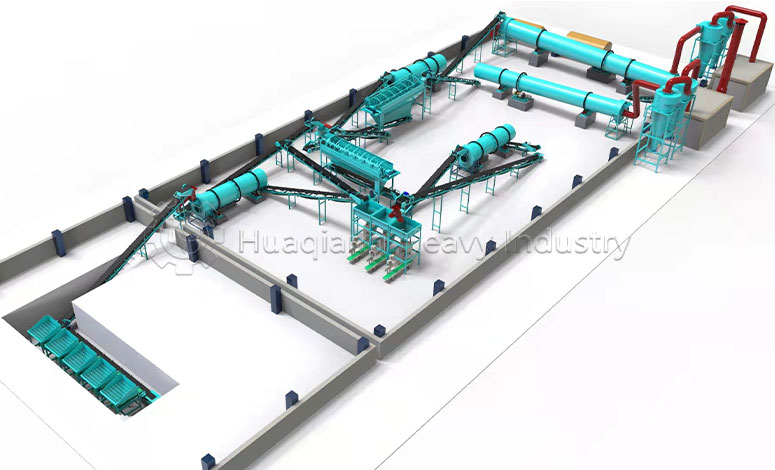
Core Process: A Four-Step Alchemy Driving Material Cycles
A modern organic fertilizer production line is a meticulously orchestrated “four-act play,” where each act is crucial and interconnected.
Act 1: The “Wall-Breaking” & Harmonizing of Raw Materials (Pre-processing System)
This is the starting point of material transformation. Various raw materials (straw, manure, sludge, mushroom residue, etc.) are gathered via loader feeding hoppers. Wet, sticky materials are forcefully broken apart by a semi-wet material crusher, while long fibrous straw is handled by a dedicated chain crusher. The crushed material is then uniformly mixed with functional microbial inoculants in a double shaft mixer. Here, the uniform feeder acts as a “precision druggist,” ensuring each raw material is added steadily according to the preset formula. The goal of this stage is to create a uniform, well-aerated “initial culture medium” that microorganisms love.
Act 2: The Microbes’ Feast (High-Efficiency Fermentation System)
This is the “heart” of the line, the core stage of biological transformation. The mixed material is conveyed to the fermentation area. In large-scale open windrow systems, the large wheel compost turner operates like a mobile steel behemoth, straddling the windrows for efficient, deep-layer turning and aeration. In factory-based indoor systems, material is placed in fermentation troughs, where a hydraulic trough turner performs precise, controlled turning via automated rail cruising. Intelligent aeration systems supply oxygen from below, while a sensor network monitors temperature, humidity, and oxygen concentration in real-time. Here, microbial communities undergo a grand 15-25 day “feast,” rapidly decomposing organic matter, forming humus, and eliminating pathogens and weed seeds.
Act 3: Refinement & Finishing (Deep Processing System)
The fully fermented and matured material becomes base organic fertilizer. Depending on market demand, it can take different refinement paths:
Powder Fertilizer Route: The material is precisely screened by a rotary screener to obtain a uniform powdered product ready for direct bagging.
Granular Route (Mainstream): This is key to value addition. The material can enter a new type two-in-one organic fertilizer granulator, which combines crushing and granulation—ideal for semi-wet materials—directly producing moist pellets. Alternatively, dried fine powder can be pelleted in a disc granulator or drum granulator. Subsequently, the pellets must pass through a dryer to remove excess moisture and a cooler to stabilize their properties. Finally, multi-layer screening machines grade the pellets. Qualified products go to the finished product silo, while oversized or undersized particles are crushed and returned to the process.
Act 4: The Birth of the Finished Product (Packaging & Storage System)
Finally, the high-quality granular or powdered organic fertilizer is efficiently elevated to the finished product silo by equipment like large angle belt conveyors. Fully automatic quantitative packaging machines complete weighing, bagging, and sealing at high speed and precision. The bagged products are palletized and sent to the warehouse, awaiting delivery to vast fields.
Beyond Machinery: The “Intelligent Brain” & Green Soul of the Production Line
The excellence of a top-tier production line extends far beyond the performance of individual machines.
The Intelligent “Central Nervous System”: The entire line is commanded by a Central Control System (PLC/DCS), which collects data in real-time and visualizes production status. It can automatically adjust turning frequency and aeration based on fermentation temperature, and tweak crushing/granulation parameters based on raw material moisture, achieving the leap from “experience-driven” to “data-driven” operation.
Closed-Loop Green Production: The production line features fully enclosed or negative-pressure design, equipped with high-efficiency dust removal and odor control systems (biofilters/chemical scrubbers) that capture and treat odors and dust, enabling clean production and harmonious coexistence with the surrounding environment.
Modular & Flexible Design: The production line can be modularly “assembled” and expanded like Lego blocks based on raw material characteristics, investment scale, and product positioning (powder/granular, standard/premium, pure organic/bio-organic), offering flexibility to adapt to different markets and policy requirements.