
【FAQ】What Happens When Coarse Particles in Raw Materials Exceed 10%? Fertilizer Granulator Process Optimization
What happens when coarse particles in raw materials exceed 10%?
The answer is clear: granulation efficiency decreases by 20%-30%, die wear accelerates, and both pellet formation rate and finished product quality decline simultaneously. This is an easily overlooked yet costly process problem in fertilizer granulation production. Whether it’s a disc granulator, drum granulator, or roller extrusion granulator, the feed particle size is a fundamental factor determining the granulation effect.
The mechanism by which coarse particles affect granulation efficiency is not complex. In wet granulation, water mainly acts on the surface of fine powder, forming a water film and liquid bridges. Coarse particles have a small specific surface area, absorb water slowly, and are difficult to bond firmly with fine powder, resulting in low pelleting rate and high return material. In extrusion granulation, coarse particles cannot smoothly enter the die orifice, causing die blockage, roller slippage, increased motor current, and decreased output. Coarse particles also cause uneven wear on the die surface, shortening die life.
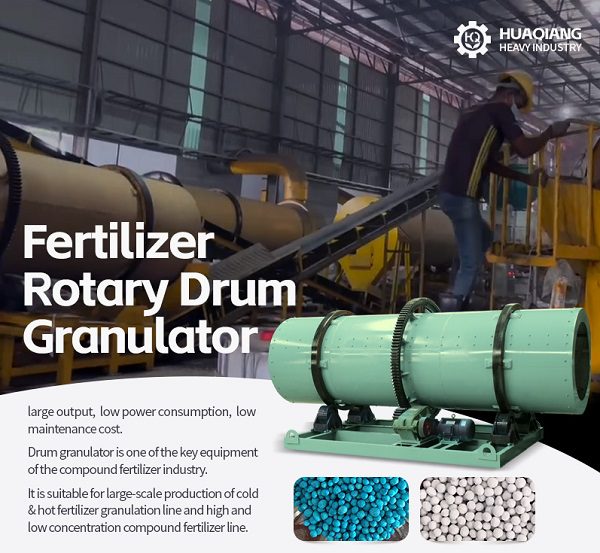
The ideal particle size control standard is as follows: For organic fertilizer disc granulation or drum granulation, the recommended feed fineness is 80-120 mesh, with coarse particles larger than 2mm accounting for no more than 10%, ideally controlled below 5%. Roller extrusion granulation requires even finer particles, typically with no more than 5% residue on an 80-120 mesh sieve. If the proportion of coarse particles exceeds 10%, a 20%-30% decrease in granulation efficiency is common, and the decrease can be even greater in severe cases.
Solving the coarse particle problem requires addressing five aspects: First, strengthen crushing. Select a suitable crusher, control the screen aperture, and regularly check hammer wear to ensure the output fineness meets standards. Second, increase screening. Install a vibrating screen before granulation to screen out coarse particles and return them to the crusher, forming a closed loop. Third, optimize the return system. Return the screened coarse particles and fine powder to the granulator in a specific ratio to stabilize the particle size distribution. Fourth, adjust granulation parameters. Appropriately increase moisture content or add binders to compensate for insufficient adhesion caused by coarse particles. Fifth, regularly maintain the die and pressure rollers. Check for gaps and replace worn parts promptly to prevent coarse particles from exacerbating equipment damage.
Preventative measures are equally crucial. Randomly check raw material particle size every shift and maintain particle size records; inspect the crusher screen every shift and replace any damaged parts immediately; control the gap between the rollers in the roller extrusion granulator to 0.2-0.5mm; adjust the tilt angle and speed of the disc granulator in conjunction with particle size adjustments. Only by incorporating particle size control into daily process management can the excessive proportion of coarse particles be avoided.
In short, a coarse particle content exceeding 10% in raw materials will directly reduce granulation efficiency by 20%-30% and accelerate die wear. Only by establishing closed-loop control across the crushing, screening, and recycling stages can granulation efficiency be stabilized, equipment lifespan extended, and the quality of finished granules guaranteed. For fertilizer companies pursuing high and stable yields, particle size control is not an option, but a mandatory requirement.