
Double Screws Compost Turner: Why Is It the Intelligent Choice for Trough Composting?
In modern large-scale composting systems, the double screws compost turner, with its unique design philosophy and efficient working mode, has become a highly favored core piece of equipment in trough-type aerobic fermentation processes. It not only perfectly addresses the inefficiency and poor uniformity of traditional turning methods but also redefines the high standards of trough composting with its advantages of intelligence and intensification.
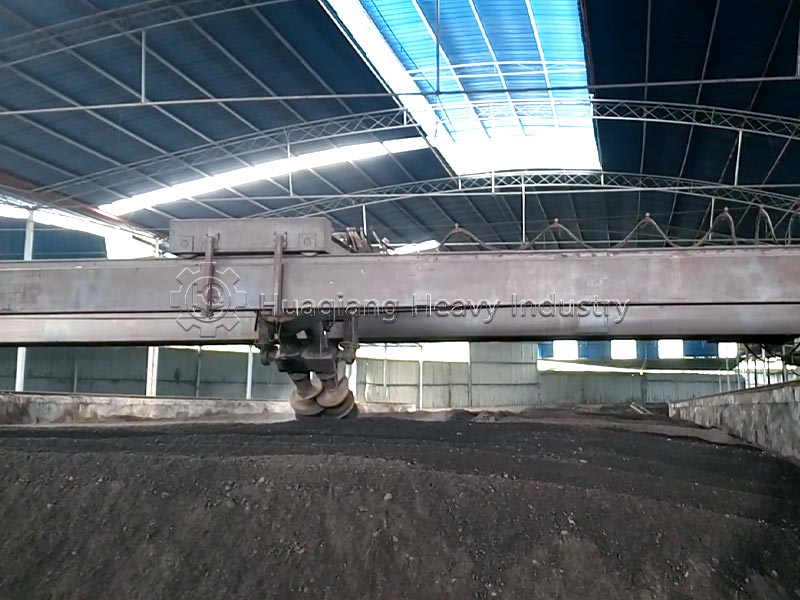
Double Screws Design: The “Intelligent Arms” for Deep Turning
The most distinctive feature of this equipment is its two parallel, co-rotating spiral shafts. This design forms the core of its operational advantages:
Thorough Turning: The double spiral blades perform a continuous action of “lifting-elevating-throwing,” completely turning the material from the bottom of the trough to the surface. This eliminates dead zones that may exist with single-screw turners, achieving 360-degree, dead-angle-free turning.
Uniform Mixing: The coordinated operation of the two screws ensures thorough mixing of materials both longitudinally and laterally, guaranteeing even distribution of moisture, temperature, and microbial populations. This significantly improves fermentation consistency and speed.
Strong Adaptability: The spiral blades are often adjustable or made of wear-resistant, flexible material, enabling them to easily handle materials containing long fibers or small debris. Their outstanding anti-winding capability makes maintenance straightforward.
Integrated Advantages of the Trough System: A Model of Intensification and Environmental Protection
The double screws turner is specifically designed for rail-mounted fermentation troughs. This combination creates unique value:
High Space Utilization: Multiple fermentation troughs can be arranged side-by-side, with a single turner serving several troughs via rail switching. This enables intensive production, particularly suitable for medium to large-scale composting projects with limited space.
Superior Environmental Control: Troughs can be easily covered with roofs or membranes. Combined with the turner’s aeration effect, this effectively minimizes odor dispersion and rainwater impact, meeting stringent environmental control requirements.
High Degree of Automation: The turner can be program-controlled for automatic travel, lifting, and turning, allowing precise control over turning frequency and depth. This significantly reduces labor dependency and operational intensity.
Comparison and Positioning: Precisely Matching Process Needs
Unlike large wheel compost turner suited for windrow composting in open areas, the double screws trough turner is the dedicated solution for enclosed trough processes. Compared to chain compost turner or turners modified from loaders, it generally offers superior performance in turning uniformity, material crushing effect, and energy consumption, making it the ideal choice for producing high-quality, standardized compost products.
Core Value: Efficiency, Quality, and Sustainability
Through its precise mechanical design, the double screws compost turner transforms the critical turning process into an efficient, controllable, and standardized operation. It directly enhances composting speed and product stability while reducing nitrogen loss, thereby increasing the agricultural value of the compost. For organic waste treatment centers, large-scale farms, or eco-agricultural parks, it is key technological equipment for achieving waste resource recovery, production automation, and product commercialization.
Conclusion: The Premium Engine for Trough Processes
Selecting composting equipment is, in essence, choosing a complete process system. With its exceptional turning performance, perfect integration with trough systems, and excellent environmental performance, the double screws compost turner proves itself to be the efficient, reliable, and intelligent core driving force in trough-type aerobic fermentation technology. Investing in it is an investment in a greener future that is more controllable, more efficient, and better aligned with modern environmental management standards.