
Large Wheel Compost Turner: The “Wind Turbine” on the Open Field, Driving Efficient Fermentation of Tens of Thousands of Tons of Material
At large-scale organic fertilizer production and massive waste processing sites, where composting operations shift from enclosed trenches to open windrow piles, a piece of equipment full of industrial presence takes center stage—the Large Wheel Compost Turner. Resembling a wind turbine standing astride long windrows, it uses its massive rotating wheel as “blades” to “blow” air, vitality, and uniformity deep into the vast piles, driving tens of thousands of tons of material through rapid, stable aerobic fermentation.
Core Advantages: Large-Scale, High-Efficiency & Deep Processing
The design essence of the large wheel compost turner lies in achieving efficient, deep turning of massive windrows with the most streamlined mechanical structure.
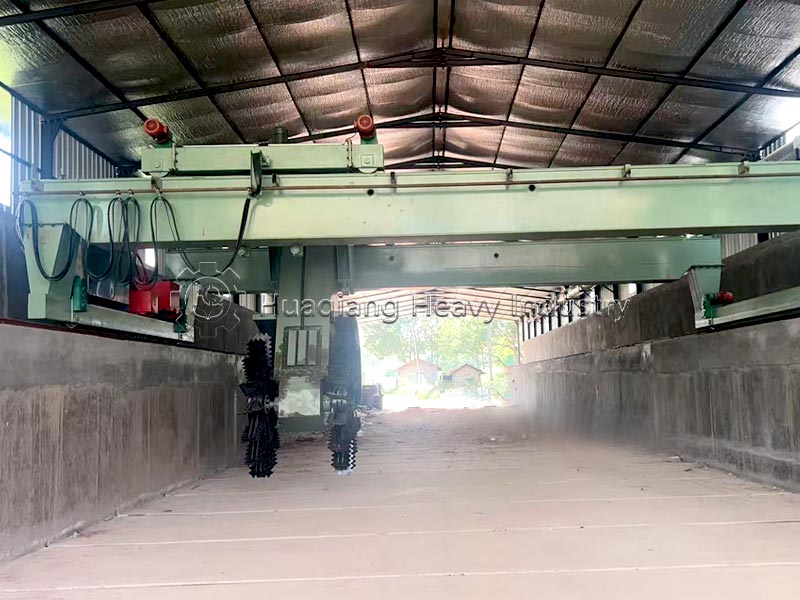
Unmatched Large-Scale Processing Capacity
Its most striking feature is the huge vertical rotating wheel (turning rotor) equipped with multiple blades. The machine straddles the windrow, with the wheel digging into the pile, completing the turning of the entire cross-section in a single pass. A single machine can process thousands of cubic meters per day, making it the absolute workhorse for large-scale materials like municipal sludge, concentrated agricultural waste, and yard waste, enabling “heavy-duty, high-speed” operation for composting projects.
Excellent Deep-Layer, Uniform Fermentation Results
The high-speed rotating blades lift material from the bottom and throw it behind the wheel, creating perfect “cross-sectional displacement.” This process achieves excellent mixing, completely breaking temperature and oxygen stratification, and effectively breaks up clumps through intense mechanical action. With great turning depth (over 2 meters), its fermentation uniformity and aeration far surpass traditional loader turning, significantly shortening the composting cycle and improving maturation quality.
Strong Terrain Adaptability & Operational Flexibility
It employs crawler or large tire undercarriages with low ground pressure, enabling stable operation even on soft ground. Independent of fixed trenches, it works directly on leveled, hardened ground, offering low investment costs and flexible layout. Its self-propelled design allows easy movement between multiple windrows; a single machine can manage an entire composting area with extremely high utilization.
Synergistic Production: The “Core Engine” of Open Windrow Composting Systems
In windrow aerobic composting systems, the large wheel compost turner is the core power unit driving the entire bioconversion process.
Synergy with “Forming Systems”: After initial windrows are built by a window former or loader feeding hopper, the large wheel compost turner begins periodic turning to initiate and maintain the composting process.
Integrated “Aeration & Conditioning”: The turning action itself is the most effective physical aeration. By adjusting turning frequency, pile temperature and oxygen levels can be directly regulated. It can also be integrated with a liquid spray system to adjust moisture or add microbial agents during turning.
Preparing Material for “Curing & Maturation”: After efficient initial turning, material can enter a static curing phase with reduced turning frequency. The turner can re-windrow the basically composted material or transfer it to a curing area.
Linking to “Downstream Processing”: The finished compost can be loaded for transport to downstream processing lines (e.g., crushing, screening, granulation) using an attached belt conveyor arm or in coordination with other loading equipment.
Evolution & Outlook: A Smarter, Greener “Mobile Composting Plant”
Facing demands for intelligence and green development, large wheel turner technology is continuously innovating:
Intelligent Navigation & Unmanned Operation: Integration of GPS/RFID positioning and auto-guidance systems enables unmanned, autonomous driving and turning along pre-set paths, moving towards “lights-out” operation with remote monitoring.
Energy Diversification & Exhaust Gas Integration: Trials using biodiesel or electric drives reduce carbon footprint. Newer models can integrate negative-pressure hoods to collect odors released during turning and direct them to treatment systems, enabling green operation.
Modularity & Multi-Function Expansion: The turning rotor module can be quickly changed—for example, swapping for ripper teeth for site preparation or integrating online temperature probes and sampling systems to become a mobile monitoring platform.