
Double Screws Turner: Two Spirals or One Lung?
I watched one being installed at a bio organic fertilizer plant last autumn. The double screws compost turner sat across a fermentation bay twenty meters long, its two huge augers hanging side by side like the tusks of some prehistoric beast. Each auger was a helix of abrasion resistant steel, nearly a meter in diameter, studded with replaceable knives. Between the augers, a set of mixing paddles completed the assembly. The whole thing weighed eight tons, yet it moved along rails with the grace of a slow moving train.
“Single screw just pushes material from one side to the other,” the old technician explained, wiping grease off his hands. “Double screws lift, separate, and fold. They open the pile like a book.”
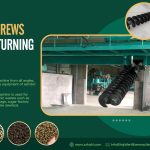
The morning of the test run, the fermentation row was ready a long, dark brown windrow of mushroom waste, rice husks, and chicken manure. Its core temperature had reached sixty eight degrees Celsius. Steam rose from the surface, carrying a sharp smell of ammonia. The operator climbed into the cab, started the diesel engine, and engaged the rotor. The two screws began to turn inward at the bottom, outward at the top. When the machine crawled forward, the screws dug into the windrow, ripped the material apart, and threw it upward in a wide, continuous fountain. The paddles between the screws caught the falling material and mixed it again before it landed behind the turner.
The sound was a deep, churning rumble not the sharp chatter of a single shaft turner, but something smoother, more like waves breaking on a gravel beach. Behind the machine, the freshly turned compost lay in a perfect, fluffy blanket. The ammonia smell was gone. In its place came the earthy sweetness of healthy fermentation. A digital thermometer pushed into the turned row showed sixty one degrees a drop of seven degrees in one pass.
“Why two screws?” I asked.
The technician pointed at the pile. “Single screw leaves a compacted layer at the bottom. The bacteria there suffocate. Double screws lift from underneath and swap bottom material with top material. Every particle sees air. Every particle gets mixed.” He knelt and pushed his hand deep into the turned compost. It offered almost no resistance. “See? Fluffy all the way through. That is what double screws do.”
Down the line, a belt conveyor was waiting to carry the turned compost to a semi wet crusher. But the turner’s job was not finished. It would make four passes over the same windrow during the next twenty days – twice the first week, then once every three days as the fermentation slowed. The operator checked the oxygen sensor mounted between the screws. The reading was nineteen percent. “Ambient air is twenty one,” he said. “Two screws get us close enough.”
When the line finally started full production, the double screws turner ran six hours a day. Compared to the roaring crusher or the rattling screener, it was almost quiet. But without its deep, patient kneading, the compost would turn sour, the bacteria would die, and the whole bio-organic line would choke on its own waste.
As I left, the operator was scraping caked compost off the auger knives. He looked up and grinned. “Single screw stirs dinner. Double screws cooks it.”