
Flat Die Pellet Machine: The Efficient Compressor for Biomass Conversion
In the global wave of renewable energy, flat die pellet machines are becoming core equipment for biomass pellet production with their unique compression technology. This efficient machinery can convert loose agricultural waste, forestry by-products, and other biomass raw materials into solid pellet fuels with high density, high calorific value, and easy storage and transportation through high-pressure physical compression, contributing significantly to clean energy development.
High-density biomass pellet fuel
Flat Die Pellet Machine: The Art of Pressure and Friction
The core working principle of flat die pellet machines lies in the synergistic action between the horizontally placed die plate (flat die) and vertically rotating press rollers. When raw materials are fed into the machine, the press rollers roll on the surface of the flat die, forcing the raw materials into the forming holes on the flat die. Under immense pressure (typically 50-150 MPa) and frictional heat, the lignin in the raw materials softens, acting as a natural binder that firmly bonds the biomass particles together.
This compression process requires no chemical binders, relying entirely on physical pressure and the inherent properties of the raw materials for forming. The forming holes on the flat die can be designed with different diameters (typically 6-12 mm) as needed to produce pellets of corresponding specifications. The entire process is continuous, efficient, and relatively low in energy consumption.
The unique advantage of flat die pellet machines lies in their simple structure and strong adaptability. Whether it’s fresh raw materials with high moisture content or dry crushed materials, efficient and stable pellet production can be achieved by appropriately adjusting process parameters.
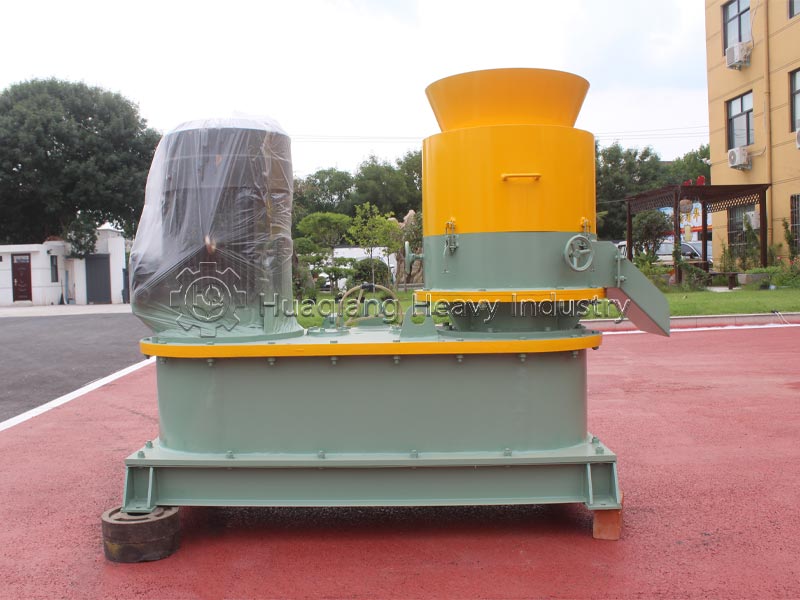
Working Principle of Flat Die Pellet Machines
Raw Material Pretreatment
Biomass raw materials are first crushed to a uniform particle size of 3-5 mm by crushers, then dried to control moisture content in the ideal range of 12-18%. Appropriate particle size distribution and moisture content are key to ensuring pellet quality and normal machine operation.
Key Parameters: Particle size 3-5mm, moisture 12-18%, temperature 60-80℃
Compression and Forming Process
Pretreated raw materials enter the pelleting chamber and are subjected to immense pressure between the press rollers and flat die. Raw materials are forced into the forming holes of the flat die, where lignin softens under high temperature and pressure, tightly bonding particles together. Formed pellets are cut by knives below the flat die, forming cylindrical pellets.
Key Parameters: Pressure 50-150MPa, temperature 80-120℃, forming speed 20-100mm/s
Cooling and Screening
Newly formed pellets are at high temperature and need to be cooled to reduce temperature and harden surfaces. Cooled pellets pass through vibration screener machine to remove powder and debris, obtaining uniform finished pellets. Non-conforming products can be returned for reprocessing, forming closed-loop circulation.
Key Parameters: Cooling temperature <40℃, pellet strength >10N, powder content <5%
Core Components and Functions
Horizontally installed thick steel plate with numerous forming holes processed on the surface. Hole shape and size determine pellet diameter and shape. Typically made of wear-resistant alloy steel with service life up to 1000-2000 hours.
Vertically installed rollers that roll on the flat die surface, applying pressure to raw materials. Typically equipped with 2-4 press rollers, evenly distributed. Roller surfaces have groove designs to increase friction and improve compression efficiency.
Main Drive System
Includes motor, reducer, and main shaft, providing rotational power for press rollers. Typically uses frequency conversion control to adjust speed according to raw material characteristics, optimizing compression effect.
Feeding System
Screw feeders or vibrating feeders uniformly and stably convey raw materials to the pelleting chamber. Equipped with overload protection to prevent clogging and damage.
Cutting Device
Rotating knives located below the flat die, cutting extruded formed pellets to required length. Knife angle and speed adjustable, controlling pellet length between 10-40 mm.
Lubrication and Cooling System
Automatic lubrication device ensures smooth operation of roller bearings; water or air cooling system controls machine temperature, preventing overheating damage.
Flat Die vs. Ring Die Pellet Machines: Choosing the Right Technology
| Comparison Metric | Flat Die Pellet Machine | Ring Die Pellet Machine |
| Structural Complexity | Simple, easy to maintain | Complex, high maintenance requirements |
| Power Requirements | Lower (15-150kW) | Higher (30-400kW) |
| Capacity Range | 0.5-3 tons/hour | 1-10 tons/hour |
| Raw Material Adaptability | Wide, suitable for various biomass | Narrower, higher requirements for raw materials |
| Pellet Density | 1.0-1.3g/cm³ | 1.1-1.4g/cm³ |
| Energy Consumption Level | Lower (40-80kWh/ton) | Higher (60-120kWh/ton) |
| Investment Cost | Lower | Higher |
| Suitable Scale | Small to medium production | Medium to large production |