
【FAQ】Fertilizer Production Process and Flow – What is the Suitable Moisture Content for Organic Fertilizer Granulation Raw Materials?
What is the suitable moisture content for organic fertilizer granulation raw materials?
The recommended moisture content for organic fertilizer granulation raw materials is between 25% and 35%. Among these, 28%–32% is considered the “golden range,” representing the range where most materials achieve the best pelletizing effect and the highest granule quality.

Why is 25%–35% the optimal range?
During the granulation process, moisture plays a dual role as a “natural binder”: appropriate moisture causes a water film to form on the surface of the powder particles, which then bind and agglomerate under mechanical force. When the moisture content is between 25% and 30%, the material has moderate viscosity, and the forming rate can be increased to over 90%, resulting in smooth and round granules. When a rotary drum granulator processes materials with this moisture content, the granule qualification rate can be consistently maintained at 95%.
What happens if the moisture content is too high?
When the moisture content exceeds 35%, the material becomes too sticky, easily causing problems such as sticking to the granulator walls, clumping, and uneven particle size. In disc granulators, if the moisture content is too high, 70% of the granules may become defective due to excessive adhesion. The granules are too soft, easily deformed after discharge, and subsequent drying energy consumption increases significantly, requiring frequent shutdowns for equipment cleaning during production.

What happens when the moisture content is too low?
When the moisture content is below 25%, the powder surface lacks sufficient water film adhesion, resulting in a significant decrease in pelleting rate. Cracks easily appear on the particle surface during extrusion granulation, and the particles are loose and brittle after drying. The forming rate is often below 60%, with a significant increase in broken material and dust, resulting in low output and excessive return material.
Fine-tuning is required for different raw materials. For materials primarily composed of livestock and poultry manure (chicken manure, pig manure, etc.): sufficient viscosity is desirable, and the moisture content should be relatively low, around 25%–30%, which is sufficient for forming.
For fibrous materials such as straw and mushroom residue: These are highly hygroscopic and have low viscosity, requiring a relatively high moisture content of 30%–35% to ensure the granules don’t break apart.
For organic fertilizers after proper decomposition and fermentation: The moisture content is typically 30%–40%, requiring the addition of dry feed or water for fine-tuning.
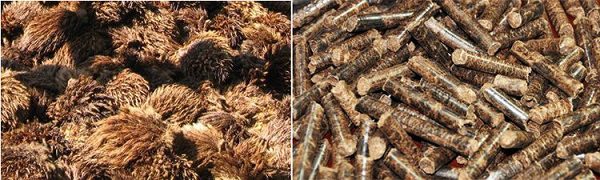
Production Control Methods
It is recommended to use a moisture meter for accurate detection. Before granulation, adjust the moisture content to the target range through drying or spray humidification. During production, it is recommended to check the material moisture content every 2 hours; any fluctuation exceeding ±1.5% requires immediate adjustment. An ideal state, according to experienced operators, is when the material can be formed into a ball when squeezed but crumbles easily upon light contact.