
Turn Chicken Waste into Gold: The Ultimate Manure Production Line
Did you know that a single chicken produces a surprising amount of manure every day? Now multiply that by a thousand, ten thousand, or a hundred thousand birds. Suddenly, you’re not just running a farm—you’re managing a mountain of waste. But here’s the exciting part: with the right equipment, that mountain can become a goldmine.
The Challenge (and Opportunity) of Chicken Manure
Raw chicken manure is too “hot” for direct field application—it burns crops and contaminates water. But after proper treatment, it transforms into black gold: organic fertilizer packed with nitrogen, phosphorus, potassium, and precious organic matter. The trick lies in the production line.
From Stinky Piles to Premium Pellets: The Complete Process
Let me walk you through a typical chicken manure organic fertilizer production line. Think of it as an assembly line that turns waste into wealth.
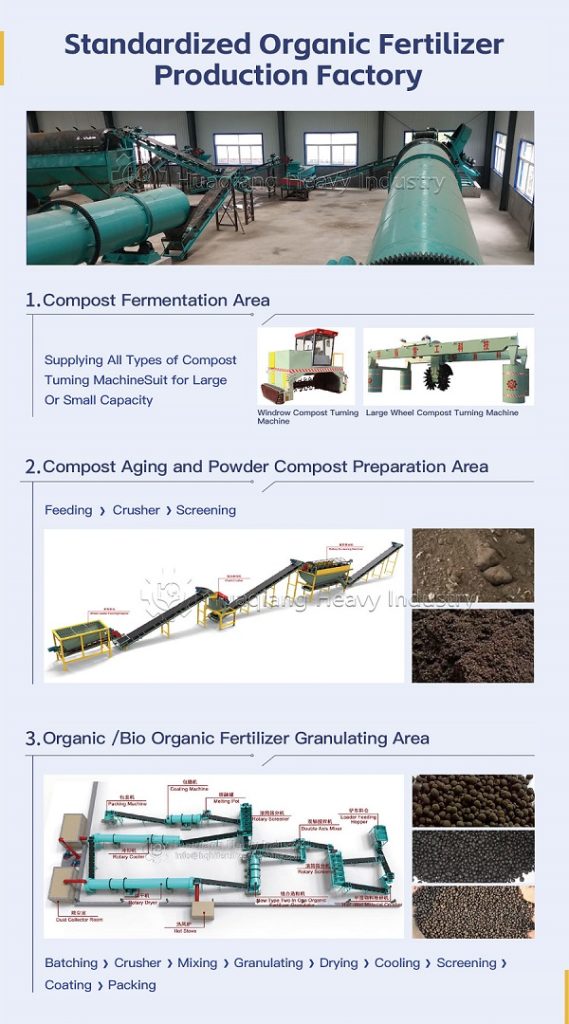
Phase 1: Pre-Treatment & Fermentation
Everything starts with composting. Fresh manure contains pathogens, weed seeds, and that unforgettable ammonia smell. We need to eliminate all three.
The raw material enters a pre-crusher to break up large clumps. Some setups include magnetic separators to remove any stray metal fragments. Then it’s off to the compost turner—either the windrow type we discussed earlier or a trough-type turner for indoor operations.
During fermentation, the temperature soars high enough to kill pathogens and weed seeds. The turner fluffs the pile regularly, ensuring oxygen penetrates deep into the material. After a few weeks, depending on the season, you have stable, odorless compost.
Phase 2: Fine Processing
Now the real magic begins. The composted material moves through a semi-wet material crusher, reducing particles to a consistent powder. A rotary screener separates oversized chunks (which go back for re-crushing) from the fine, consistent powder.
Want granular fertilizer? This is where you choose your path.
Path A: Powder Power
For powdered organic fertilizer, you’re almost done. The fine material goes into a storage silo then to an automatic packaging scale, ready for bagging. Simple, cost-effective, and perfect for local markets.
Path B: Premium Pellets
Granular fertilizer commands higher prices and handles better in spreading equipment. Here’s how it’s made:
The fine powder enters a granulator—options include disc granulators, rotary drum granulators.
Next comes drying and cooling. A drum fertilizer dryer reduces moisture to the ideal level, followed by a cooler that brings pellets to ambient temperature. Another screening separates oversized pellets (crushed and recycled) from on-spec product.
Optional but recommended: a coating machine applies a protective layer, preventing caking and enhancing appearance. Finally, the automatic packing scale fills bags with robotic precision.
Real-World Success: From Problem to Profit
Take the case of Hubei Province’s Guanhu Farm Community. They installed an integrated aerobic fermentation system that handles poultry manure, crop straw, and mushroom residue completely enclosed. The process runs automatically—mixing, feeding, fermenting, oxygen supply, turning, monitoring, and even exhaust purification. After a suitable period in the fermenter, followed by secondary curing, waste becomes valuable organic fertilizer with zero environmental complaints.
What’s Your Scale?
Production lines range from compact setups perfect for starting out to industrial-scale operations. The beauty is modularity: start with powder production, add granulation later when markets grow.
The Bottom Line
Chicken manure isn’t waste—it’s raw material. With the right production line, you’re not just solving a disposal problem; you’re creating a revenue stream. Plus, you’re closing the nutrient loop, returning organic matter to soil that desperately needs it.
Ready to turn your chicken operation into a fertilizer factory? The equipment exists. The technology is proven. The only question: what are you waiting for?