
The Giant Wheel Rolls – Who Gave This Compost Turner Such Attitude?
From a distance, it looks like a heavy roller that escaped a construction site. But get closer, and you realize this beast doesn’t roll roads – it turns compost. Meet the large wheel compost turning machine – the super heavyweight of any production line. Today, let’s stand at its installation site and see how those giant wheels flip a 50 meter long windrow completely upside down.
The first thing that shocks you on site is the pair of wheels, nearly two meters in diameter. Each wheel is densely studded with dozens of throwing teeth, like the fangs of a beast. The entire machine straddles the fermentation trench or windrow, with rails laid on both side walls. Workers are busy hoisting the wheel assembly into place. An overhead crane lowers it slowly, while an old hand stands below, directing with his hands like a traffic cop: “Down – keep coming – good! Stop!” The axle of the wheels must be absolutely parallel to the rails – not even a millimeter off. A young worker aims a laser alignment tool, sweat pouring down his forehead.
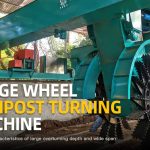
The “attitude” of this large wheel turner comes from its hydraulic system and drive motors. As the wheels spin, the throwing teeth cut into the material at high linear speed, shattering the compost and flinging it backward, while the whole machine creeps forward along the rails. In one pass, it can completely aerate a pile up to 1.5 meters deep – bringing the 70–80°C inner core to the surface to shed heat, while the drum fertilizer cooler outer material sinks to the middle to continue fermenting. During installation, every hydraulic hose fitting must be wrapped tight with Teflon tape and torqued to spec – not too much, not too little. One worker jokes, “If this thing leaks oil, it’s worse than a guy with diarrhea.”
Of course, a turner alone isn’t enough. All around it, a whole team of equipment stands ready. Up front: a batching system and a mixer – blending kitchen waste, straw, and manure in the right ratios, adding water to adjust moisture, and mixing into a uniform mass. The turner works on material already piled into windrows or filled into trenches. It makes several passes a day, keeping the pile oxygen rich and temperature even. Behind the turner come a transfer car or belt conveyor – moving the turned material to the next stage, such as an aging area or a screener. The screener separates finished material into fines and coarse residue. The fines go to a disc granulator or ring die pellet machine to be turned into pellets, while the coarse residue goes back to the front for another round of fermentation. Step by step, smelly waste becomes dark, shiny organic fertilizer.
On test day, the large wheel turner gets power for the first time. The wheels spin slowly – just a low hum from the hydraulic pump. The operator pushes the forward button, and the whole machine moves steadily along the rails. The throwing teeth bite into a test load (wet sand standing in for real material), and sand flies high into the air like a brown waterfall. The old hand stands by the control panel, watching the ammeter and speed display. “RPM normal, current stable, travel synchronized – that’s it.” He pats the machine’s side guard and grins: “This guy’s got muscle and no picky appetite – feed it anything and it’ll turn it.”
So don’t be fooled by its brute looks. Those giant wheels don’t just lift dirt – they lift oxygen. What they roll over isn’t just material – it’s time. Without this machine, dozens of tons of compost would have to be turned shovel by excavator – burning fuel, labor, and still leaving uneven spots. With it, one trench or one row of windrows can finish a perfect aerobic fermentation in just days. Isn’t that what they call “brute force makes miracles”?