
Chain Compost Turning Machine: The Fermentation Tank’s Tireless Dancer
Have you ever stood beside a long, narrow fermentation trench packed with steaming manure and wondered how on earth anyone could turn that mountain of material—day after day—without losing their mind? The answer is a machine that looks like something between a bridge and a beast: the chain compost turning machine. And it doesn’t just turn compost. It breathes life into it.
What Is a Chain Compost Turner?
Imagine a steel frame that straddles a concrete fermentation groove, running on rails laid along the trench walls. Suspended from that frame is a series of heavy duty chains, each fitted with steel paddles or digging teeth. As the machine inches forward, the chains rotate, flailing into the compost pile, lifting, shredding, and throwing the material backward. With every pass, the turner transforms a stagnant, oxygen starved heap into a fluffy, aerated, biologically active mass.
This is the chain compost turning machine—also known as a chain plate turner or groove type turner—and it’s the heart of large scale organic fertilizer production.
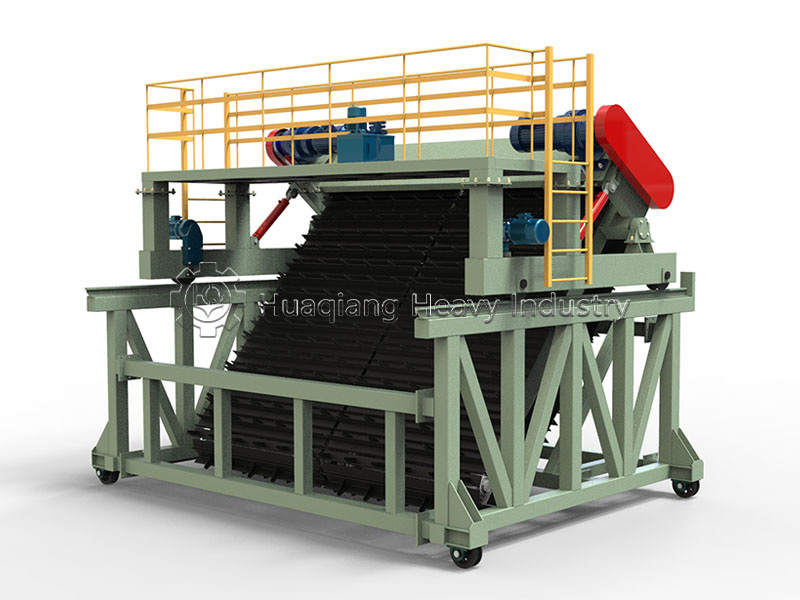
How It Works: Simplicity with Power
The principle is surprisingly straightforward. The machine rides on rails along the fermentation trough—often 3 to 10 meters wide and up to 100 meters long. Chains equipped with hardened steel plates or blades rotate at controlled speeds, diving deep into the material. They lift compost from the bottom to the top, break up clumps, and fluff the pile to introduce oxygen. The turning depth can reach 1.5 to 2 meters, processing massive volumes in a single pass.
Most modern chain turners also include a hydraulic lifting system, allowing the operator to raise the chains when the machine moves back to the start, avoiding unnecessary wear and preventing damage from large obstructions.
Why Chains? The Real Advantage
Compared to other turners (like large wheel compost turner), the chain turner offers unique strengths:
Deep turning – reaches the bottom of the trench where anaerobic zones often hide.
Uniform mixing – chains throw material in a sweeping motion, creating a homogeneous blend with every pass.
Handles wet, sticky materials – poultry litter, cow manure, and sludge don’t clog the chains like they might clog screws.
Energy efficient – simple mechanism, less power consumption per ton of compost.
Low maintenance – fewer complex moving parts than hydraulic-driven screw turners.
The Team Behind the Turner
Like any great performer, the chain turner doesn’t work alone. It’s part of a full organic fertilizer production line:
Mixer – blends raw manure, straw, and microbial inoculant before fermentation begins.
Hydraulic lifting system – integrated with the turner to protect the chains and extend machine life.
Aeration system – some troughs have perforated floors for forced aeration, working in tandem with the turner.
Crusher & screener – refine the mature compost after fermentation.
Granulator, dryer, cooler, packer – convert the compost into finished organic or bio organic fertilizer.
The Fermentation Process: Where Magic Happens
Fresh organic waste—manure, mushroom residue, crop stalks—is loaded into the fermentation trough. The chain turner makes its first pass, fluffing the material and activating aerobic microbes. Within 24 hours, the core temperature rises to 60-70°C, killing weed seeds, pathogens, and fly larvae. Over 15-25 days, with the turner passing 3 to 5 times per week, the pile transforms: the stench disappears, the color turns dark brown, and the material becomes crumbly and earthy-smelling. That’s mature compost—ready for further processing.
Why This Machine Matters
In an era where chemical fertilizer prices fluctuate wildly and soil health is collapsing, organic fertilizer offers a sustainable alternative. But making quality organic fertilizer at scale requires reliable, efficient equipment. The chain compost turning machine makes large-scale composting practical, affordable, and consistent.