
One Big Wheel Rolls – Turns Cow Manure into Black Gold?
What’s the biggest headache on a cattle farm? Mountains of cow manure, no doubt. But if you have a large wheel compost turner, that smelly waste can become premium organic fertilizer. Today, let’s walk into a cow manure fermentation site and see what makes this “big wheel monster” so special – and meet its right hand helpers along the way.
Feature one: Deep turning and high windrows.
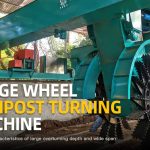
The two giant wheels on a large wheel compost turner are usually over two meters in diameter, lined with rows of sturdy teeth. As the wheels spin, the teeth dig deep into the pile like giant claws, throwing hot material from the bottom to the top while burying the cooler outer material down below. One pass can reach a depth of 1.5 to 1.8 meters, and the pile height can be kept at 1.8 to 2 meters. That means more manure processed per square foot and double the fermentation efficiency. Ordinary turners manage only about one meter – the large wheel type is a real long armed giant.
Feature two: Powerful shredding and uniform mixing.
Cow manure often comes mixed with straw, sawdust, and corn stalks – fibrous materials that easily wrap around the shafts of ordinary turners. The large wheel turner, with its low speed but high torque rotation, breaks and shreds those fibers like a hammer mill. The output is as uniform as loose soil. Aerobic microbes multiply rapidly, and the pile temperature climbs above 65°C within three days – hot enough to kill parasite eggs and weed seeds.
Feature three: High level of intelligence.
Modern large wheel compost turners are equipped with hydraulic lifting systems that automatically adjust the wheel position according to the pile height. Some even come with remote control and GPS positioning. One person sitting in a cab – or even an office – can control the entire turning operation over a long fermentation bay. The machine moves to the end, automatically lifts, shifts sideways, and reverses. It works more obediently than an old ox.
Of course, a large wheel turner alone isn’t enough. A complete cow manure fermentation line needs other equipment to work in harmony:
A double shaft mixer blends manure with bulking agents (straw, sawdust) and microbial inoculants until they are thoroughly combined.
Belt conveyor move the mixture to windrows or fermentation trenches.
During turning, if moisture is too high, a mobile sprayer or forced aeration system can help.
After fermentation, a screener separates coarse fibers (sent back for further fermentation) from fine material.
The fine material then goes to a disc granulator or a roller press granulator to be formed into pellets.
Finally, a dryer, cooler, and packaging scale turn the pellets into bags of “black gold.”
On the installation site, workers are fastening the rails for the large wheel turner. An old hand checks the rail level with a laser level, muttering, “If the rails are off by two millimeters, the wheels will dance as they move – and the turning depth will be uneven.” The two massive wheels have already been hoisted into place, their teeth glinting in the sunlight. Nearby, fresh cow manure sits in a pile, gently steaming.
So don’t lose sleep over cow manure anymore. The large wheel compost turner and its partners can turn your manure into odorless, fluffy, nutrient rich organic fertilizer in just 15 to 20 days. One roll of the big wheel – the stench fades away. Another roll – black soil turns to gold. Isn’t that the cattle farm’s very own Transformer?