
Disc Granulator: The “Snowball Master” of Fertilizer World
Have you ever seen compost powder transform into round pellets? Just like children making snowballs, the powder rolls, adheres, and grows on a tilted disc—the disc granulator is that “snowball master.” But no master works alone; behind it stands a dedicated team of equipment.
On an organic fertilizer production line, the most poetic step is granulation. And the star of this step is often an inclined, slowly rotating pan—the disc granulator. It mixes pulverized organic materials (like fermented manure, straw powder, oilseed cakes) with just the right amount of water or steam. Using centrifugal force and friction from rotation, the powder layers upon itself like a snowball, eventually spilling over the rim as uniform pellets. The process resembles an elegant waltz—the disc is the stage, and the powder is the dancer.
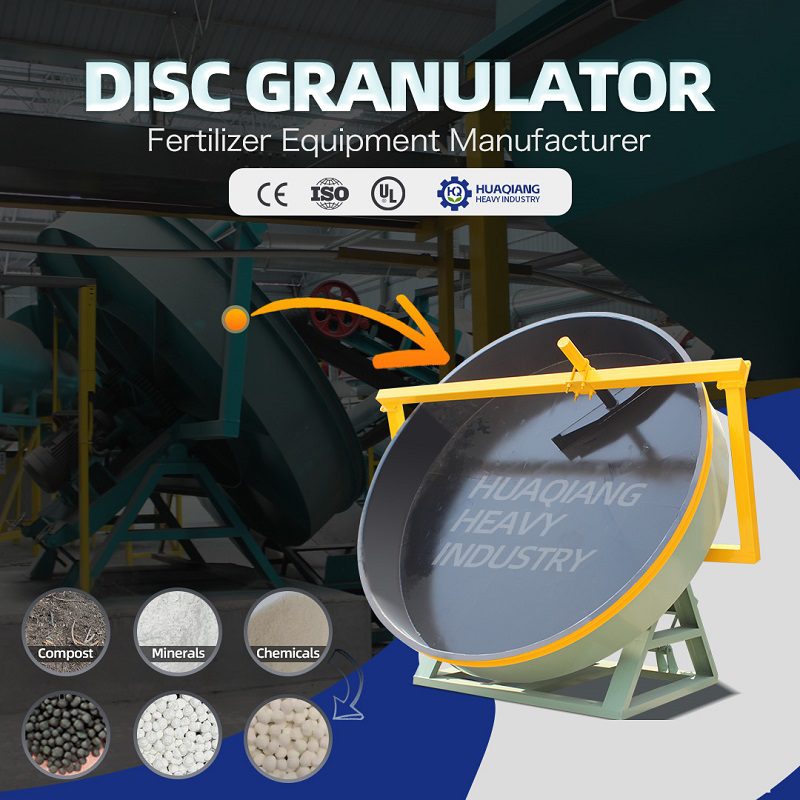
However, a disc granulator alone cannot complete the transformation from raw material to marketable fertilizer. Before it takes the stage, a crusher must break down large chunks into fine powder—common choices like the semi-wet material crusher or chain crusher can instantly reduce even high-moisture materials, providing qualified “raw powder.” Then, the batching system and mixer step in: precisely weighed nitrogen, phosphorus, potassium, or micronutrients join the organic powder in a horizontal mixer or double-shaft paddle mixer, achieving perfect homogeneity within minutes, ensuring every pellet contains balanced nutrients.
The wet pellets produced after granulation carry high moisture and must immediately go to a dryer. A rotary drum dryer uses hot air passing through the material curtain to remove moisture and harden the pellets; then they enter a cooler, where ambient or forced air rapidly lowers their temperature to prevent moisture reabsorption and caking. Cooled pellets are sorted by a vibration screener machine: qualified products go to an automatic packaging machine for bagging and sealing; fines and oversized particles are returned to the granulator or crusher to rejoin the “snowball game.” Additionally, the whole line relies on auxiliary equipment like belt conveyors and elevators to connect each stage into a smooth flow.
This lineup of equipment is not fixed; it adapts to raw material characteristics, production scale, and pellet specifications. For instance, materials high in humic acid might benefit from a roller extrusion granulator as a supplement; for pure organic fertilizer, the disc granulator is often the most economical choice. Its advantages are clear: high pelletizing rate (over 90%), round pellets, intuitive operation, low energy consumption, and quick formula changes—just clean the disc for a few minutes and switch.
During a visit to an organic fertilizer plant, the manager pointed at the running disc granulator and said with a smile, “Once the disc spins, I can tell with one glance whether today’s pellets will be round.” But then he gestured toward the dryer and screen: “Without them to ‘set’ and ‘beautify’ the pellets, even the roundest ones wouldn’t become a saleable product.” Indeed, the disc granulator is the star, but the crusher, mixer, dryer, cooler, screen, and others form its solid backing. It is their interlocking cooperation that transforms messy waste into uniform, plump “black gold,” returning to the fields to nourish crops.
So next time you hold a handful of organic fertilizer pellets, imagine the journey behind them: from towering piles of raw material, to the roar of the crusher, the tumble of the mixer, the spinning dance on the disc, the hot breath of the dryer, and the gentle sifting on the screen—before finally slipping into the bag. This is the perfect collaboration of equipment, and a microcosm of modern organic farming’s technology.